
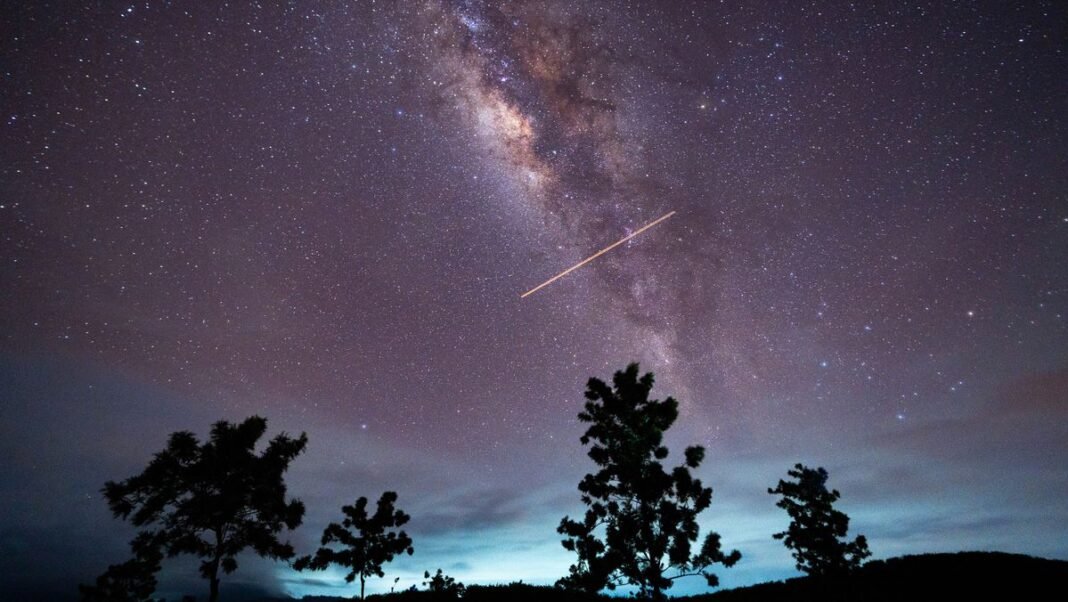

Clear skies and a moonless night are offering people in the UK a prime opportunity to witness the spectacular Orionid meteor shower lighting up the sky post-midnight. This annual event, occurring approximately 60 miles above Earth and lasting for about a week towards the end of October, will peak in the early hours of Wednesday, October 22. Traveling at speeds of around 41 miles per second, the bright meteors are set to create a dazzling display.
Known as the Orionids, these meteors are remnants of debris left behind by Halley’s Comet as it orbits the Sun. Halley’s Comet, visible from Earth roughly every 75 to 76 years, is expected to make its next appearance in 2061. As comets move along their orbital paths, they leave behind trails of debris that Earth encounters, resulting in these particles burning up in our atmosphere and producing luminous streaks known as “shooting stars.”
Out of the approximately 30 meteor showers visible each year, the Orionids stand out as some of the brightest and most prominent. These meteor showers are named after the constellation from which they appear to radiate, rather than the comet from which they originate, with the radiant point for the Orionids situated in the constellation Orion the Hunter.
During the peak of the Orionids in the early hours of Wednesday, sky enthusiasts may witness up to 15 meteors per hour hurtling through the sky at speeds reaching up to 148,000mph. Contrary to popular belief, telescopes or binoculars are not necessary to view meteor showers; in fact, they are best enjoyed with the naked eye for a more immersive experience.
The Orionids can be seen from both the Northern and Southern hemispheres between midnight and dawn. To optimize the viewing experience, individuals are advised to find a dark location away from city lights with a clear view of the sky, lying flat on their backs with feet pointing southeast, as recommended by NASA for Northern Hemisphere observers.
Following the peak, meteor activity will gradually decline, although spectators in Scotland may still catch a remarkable display on Wednesday night. Clouds and rain moving northward might hinder visibility in other parts of the UK. Clearer conditions are expected to return by the end of the week, enhancing night-sky viewing, with the Orionids remaining active until November 7.
While Halley’s Comet, the source of the Orionid meteor shower, won’t be visible until 2061, other comets may be visible this week. The easily recognizable Orion constellation, notably visible in the Northern Hemisphere, ascends in the eastern sky post-midnight, just north of the red star Betelgeuse. BBC Sky at Night Magazine suggests locating it by looking for a line of three bright stars closely aligned, known as Orion’s Belt.
Observers in the Northern Hemisphere might also catch a glimpse of Comet Lemmon or Comet SWAN, both making their closest approach to Earth on Tuesday. Comet SWAN takes approximately 22,554 years to orbit the Sun, while Lemmon completes an orbit roughly every 1,350 years.