

Communities across East and Southeast Asia are preparing for the upcoming Lunar New Year celebrations, scheduled for February 17th this year and spanning a 15-day period.
Within the Chinese zodiac cycle, each year is associated with an element. As the Year of the Fire Horse approaches, it signifies a time for significant life changes, characterized by intense action, personal development, and a heightened pace of living.
Given that this particular zodiac year occurs only once every 60 years, many individuals may not experience it again in their lifetime.
To commemorate the Year of the Fire Horse, we caught up with author Angela Hui, who expressed her fondness for the Lunar New Year festivities and the cherished moments shared with loved ones. Additionally, she generously shared a delightful recipe that you can easily recreate at home.
Prior to delving into the culinary experience, why not engage in a creative activity by crafting your own fire horse through the traditional Chinese art of paper folding, as demonstrated by Tesco? Simply access the provided sheet and follow the instructional video for a fun and engaging experience.
Renowned as “Asian Christmas” in many households, Lunar New Year stands as the most significant holiday on the calendar, emphasizing family reunions, ancestral reverence, and the welcoming of good luck.
Personally, what resonates most during this period is the opportunity to collaborate with my mother, a skilled chef, in the kitchen. Our connection revolves around food, serving as our unique form of communication.
As we engage in culinary activities together, time seems to fade away. Whether we are chatting like old friends while preparing dumplings or quietly chopping vegetables side by side, there exists a comforting harmony in the kitchen. The unspoken rhythm of working together transcends the need for words, and our mere presence suffices.
Food not only plays a pivotal role in our bonding but also influences how we structure our celebratory feast. In Chinese tradition, symbolic foods are served to represent aspirations for the upcoming year.
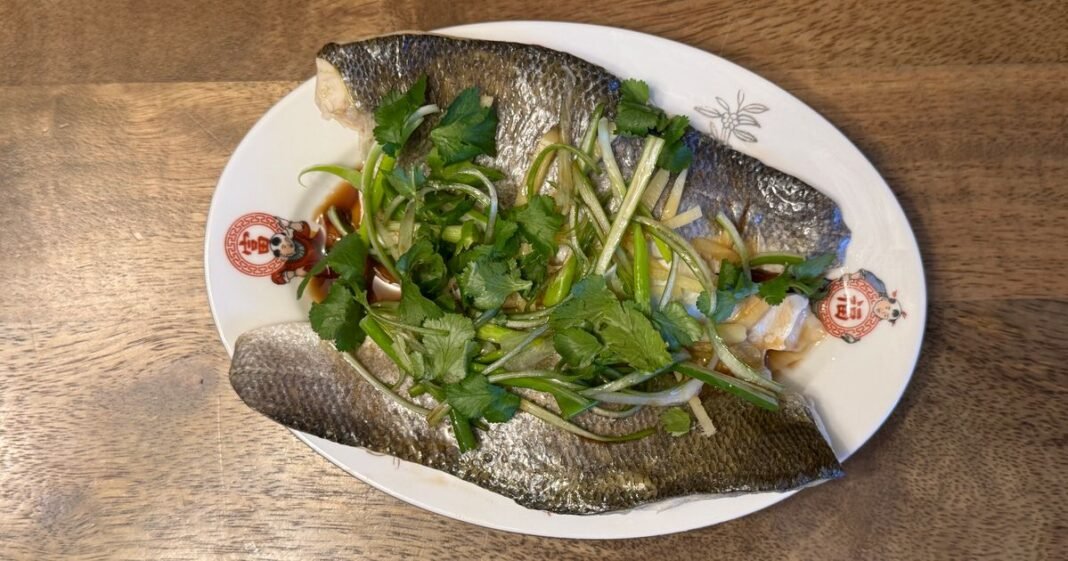
Engrossed in planning our family’s Lunar New Year menu, we exchange recipes, photos, videos, and voice notes days in advance. “A whole steamed fish is essential,” my mother insists: “年年有余, leen leen yow yu.”
In Cantonese culture, the term for fish, yu, phonetically resembles words associated with abundance and surplus, embodying the desire for continuous prosperity.
Considering the significance of symbolic foods, I propose creating money bag dumplings using cabbage wrappers. Dumplings symbolize wealth, with the belief that consuming more will lead to increased prosperity, given their resemblance to ancient gold ingots.
After numerous exchanges and deliberations, our menu is finalized with eight dishes symbolizing fortune, luck, and fulfillment.
For those eager to recreate the Lunar New Year experience at home, I have shared my steamed fish recipe below, featuring ingredients readily available at Tesco.
Ingredients
1 seabass, whole or filleted, gutted, and descaled
1/4 tsp white <a rel="nofollow" target="_blank" href="https://www.t