
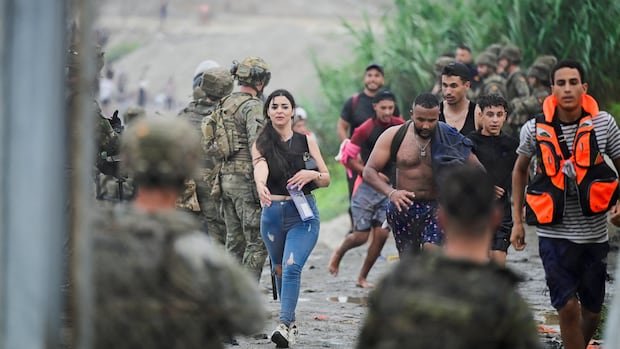

Spain and Morocco have strengthened the border fence of a Spanish enclave, significantly reducing mass crossings after tens of thousands of individuals arrived by sea and land in a single day. According to officials, at least 57 people have lost their lives following the entry of around 60,000 individuals into Ceuta in recent days. By 6 p.m. local time on Friday, an estimated 48,300 migrants had voluntarily returned to Morocco as reported by Spain’s Interior Ministry.
The sudden influx of people into Ceuta, a small Spanish territory protruding into the Mediterranean from Morocco, caused shock and discord in Europe. France announced heightened border checks with Spain, and Italy threatened to suspend Spain from the European Union’s internal open border scheme. Moroccan authorities at the gates of Ceuta utilized water cannon trucks, batons, and tear gas to push back individuals attempting to cross the border.
Spanish authorities expressed their intention to swiftly expel those who entered illegally, despite a court ruling imposing restrictions on special “border rejection” regulations that permit immediate expulsions from the enclave. Spanish Prime Minister Pedro Sanchez condemned the mass crossings on Friday, labeling them as a violation of Spain’s territorial sovereignty. He urged Morocco to intensify efforts to reduce the outflow of people.
Ceuta and Melilla, another Spanish autonomous city in northern Morocco, have the European Union’s sole land borders with Africa. These cities, each hosting approximately 85,000 residents, occasionally witness surges in attempted crossings by migrants aiming to reach Europe, although the scale of the recent rush was unprecedented.
The surge in crossings may have been influenced by a recent ruling by Spain’s Supreme Court, which stated that migrants intercepted at sea while trying to reach Ceuta or Melilla cannot be summarily returned under special rules. Migrants attempting to reach Ceuta often swim from the Moroccan town of Fnideq, covering about five kilometers to reach Spanish territory. On the Moroccan side, despite reinforced security measures thwarting most crossing attempts, thousands of migrants headed towards Fnideq overnight.
While the migration issue remains sensitive across Europe, with a surge in right-wing parties since the 2015 crisis, various countries have responded differently. French Interior Minister Laurent Nunez announced a fivefold increase in police presence on the Spanish border. German Chancellor Friedrich Merz welcomed Spain’s stance against illegal migration, while Italy’s Prime Minister Giorgia Meloni threatened extraordinary measures, including suspending the Schengen Area with Spain, to defend borders and citizen safety.
In the U.S., President Donald Trump criticized Spain’s Socialist-led government, labeling the Ceuta crossings as an “invasion.” Spain’s Socialist government, despite standing firm against illegal crossings, emphasizes the economic contributions of immigrants, supported by decades of data. Spain has also offered a mass amnesty resulting in hundreds of thousands of individuals seeking citizenship in the past year.
Italy’s Foreign Minister Antonio Tajani criticized Spain’s citizenship grant to irregular immigrants, prompting a response from Spanish Foreign Minister Jose Manuel Albares, who deemed Tajani’s message inappropriate and called for solidarity rather than partisan accusations from partners.