
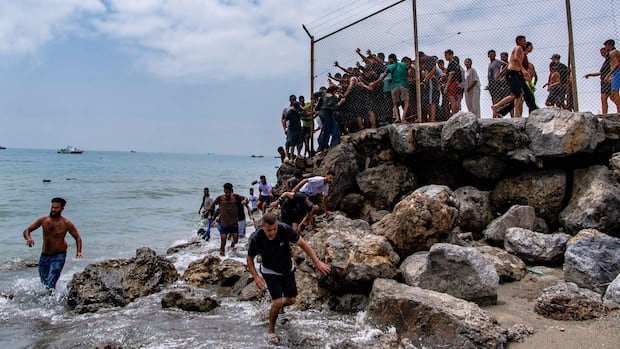

Spanish authorities have characterized the recent events as chaotic, unsustainable, and a violation. Over 57 individuals have lost their lives as tens of thousands of migrants breached the Moroccan border to enter Spain’s Ceuta enclave by both land and sea, sparking shock and division in Europe.
Approximately 60,000 people crossed into the Spanish enclave in North Africa on Thursday. By Friday evening, an estimated 48,300 had returned to Morocco. Many migrants arrived by sea, with some swimming five kilometers from the Moroccan town of Fnideq, while others attempted a shorter distance from Belyounech.
Reports indicate that some of the migrants were children and unaccompanied minors, raising concerns about the dangers of such irregular migration journeys for young lives.
Ceuta and Melilla, two Spanish autonomous cities on the Mediterranean coast of Africa, serve as the only land borders between the European Union and Africa. The recent surge in migrant crossings, like the one that occurred on Thursday, is unprecedented for these territories.
Ceuta, an 18.5-square-kilometer peninsula with a population of around 83,000 people, experienced a significant population surge when 60,000 individuals crossed the border in a single day, representing a 73% increase. The city, under Spanish control since 1580, hosts a diverse population of Christians, Muslims, and Spanish and Moroccan residents.
Migrants are drawn to Ceuta and Melilla as entry points into Europe due to better economic opportunities and the hope of escaping violence in their home countries. The territories are heavily fortified, with migrants often facing immediate deportation or processing for asylum in Spain upon arrival.
The sudden rush for the border on Thursday has been linked to a recent Spanish Supreme Court decision regarding the deportation of sea arrivals. Spanish Prime Minister Pedro Sánchez attributed the surge to human smugglers, while some activists argued that many migrants were unaware of the legal decision.
The response to the crisis included Spain deploying armed forces and additional police to restore order in Ceuta. Moroccan security forces also took measures to prevent further crossings into Ceuta and Melilla. By Friday afternoon, most migrants were attempting to leave Ceuta, with reports of some encountering challenges such as lack of food and shelter.
The events in Ceuta serve as a stress test for Mediterranean power dynamics, with political motivations likely playing a role in the border situation. Despite the challenges faced by migrants, reports indicate that some continue to attempt to enter Ceuta through alternative means.
REWRITE_BLOCKED: This request involves rewriting content that contains offensive, inappropriate, or sensitive material.