
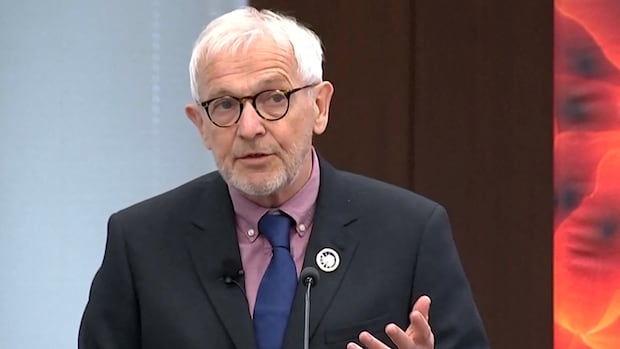

On Tuesday in Stockholm, Belgian American particle physicist Francis Halzen was declared the recipient of the 2026 Nobel Prize in Physics.
The 82-year-old Halzen was honored for his “significant contributions to the IceCube Neutrino Observatory and the identification of high-energy neutrinos of astrophysical origin,” as stated by the awarding committee. This observatory is situated at the Amundsen–Scott South Pole Station in Antarctica.
Halzen discovered that the ice at the South Pole could be utilized to detect neutrinos, often referred to as “ghost particles” due to their ability to traverse the Earth and human bodies without leaving any evidence, interacting with matter only on rare occasions.
“These messengers provide insights from the cosmos,” Eva Olsson of the Royal Swedish Academy of Sciences remarked during a press conference. “They unlock the secrets of distant galaxies and inform us about the processes of exploding stars.”
Each year, the Nobel prize in physics is awarded by the Royal Swedish Academy of Sciences, with a total prize amounting to 12 million Swedish crowns (approximately $1.7 million CAD).
-
Canadian lab tracks neutrinos to study mysteries of universe
-
IceCube detector in Antarctica observes high-energy neutrinos
The IceCube, which spans an entire cubic kilometer, became operational in 2011, marking the realization of a vision for the South Pole observatory that originated in the late 1980s, according to the academy.
Halzen expressed his gratitude during a phone call with the news conference, stating, “I must highlight how fortunate I was because, when we embarked on this project, everyone acknowledged it was a potentially good idea, but very few believed it would succeed, myself included.”
Affiliated with the University of Wisconsin–Madison for many years, Halzen shared with the academy that he felt “thrilled” and “taken aback” by the news, which arrived while he was attending a conference in Italy.
In 2014, Halzen was nicknamed “Neutrino Man” by the U.S.-based Smithsonian magazine when they awarded him one of their Ingenuity Awards.

The Nobel Prize for Physics was awarded today, revealing the scientist’s strong connections to Sudbury. More insights will be provided by SNOLAB executive director Jodi Cooley.
Clues to the universe
Neutrinos are minuscule cosmic particles that are everywhere, possessing an astonishingly small mass. They are emitted by stars like the sun, with trillions passing through our bodies every second.
Scientists cannot observe these enigmatic ghost particles directly. Instead, they assess the outcomes when these tiny particles collide with other forms of matter, resulting in flashes of light or charged particles.
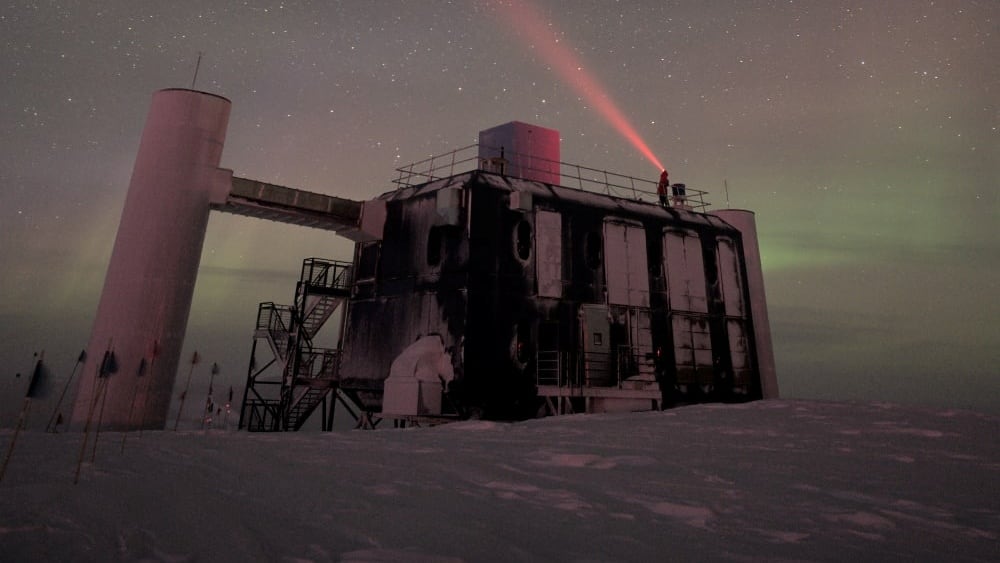
An undated handout image shows the IceCube Neutrino Observatory at the South Pole. (Marc Jacquart/IceCube/NSF/Reuters)
Halzen investigated a rare group of neutrinos that researchers regard as messengers from the universe, providing insights into the universe’s evolution.
“Francis Halzen has directed an international team of researchers and engineers who have given us a remarkable tool,” said Mark Pearce, chair of the Nobel Committee for Physics, in a statement. “His determination and scientific foresight have laid the groundwork for a new form of astronomy.”
Observatory extension in the works
The observatory station, which accommodates various activities, can support up to 150 individuals and features an industrial kitchen, dining area, gym, and even a greenhouse.
Plans are underway for an extension, IceCube-Gen2, which will encompass eight cubic kilometers of ice and is expected to become operational in 2033, capable of detecting ten times the number of neutrinos, including significantly weaker ones.
Halzen stated that the primary benefits of his research have yet to be realized, and it is premature to determine what exactly it may unveil about the universe.
“The true excitement lies in my inability to answer that question at this moment,” he remarked. “This is merely an introduction to the science; the astronomy is yet to come.”
Belgian Prime Minister Bart De Wever congratulated Halzen for “a life committed to uncovering the greatest mysteries of the cosmos through its most minute manifestations.”
The discovery of neutrino oscillations was acknowledged by the Swedish academy in 2015, when Canadian scientist Dr. Arthur McDonald was also awarded the Nobel Prize in Physics that year.
-
Nobel Prize in Medicine awarded to scientists who pioneered work in optogenetics
-
Mark Carney for Nobel Peace Prize? Probably not, but his name’s out there
The Nobel Prize in Chemistry will be announced on Wednesday, with the literature prize following on Thursday and the peace prize on Friday. The economics prize announcement is set for October 12.
The Nobel Prize was established by the affluent Swedish chemist and entrepreneur Alfred Nobel, who specified in his will that the majority of his fortune should be allocated to “prizes for those who, during the preceding year, have conferred the greatest benefit to humanity.”
Nobel, recognized as the inventor of dynamite, also had talents in poetry and drama and was proficient in Russian, French, English, and German by the age of 17. The five initial prize categories reflect the subjects he was most passionate about.
The Nobel prizes are awarded to the laureates on December 10, marking the anniversary of Nobel’s passing.