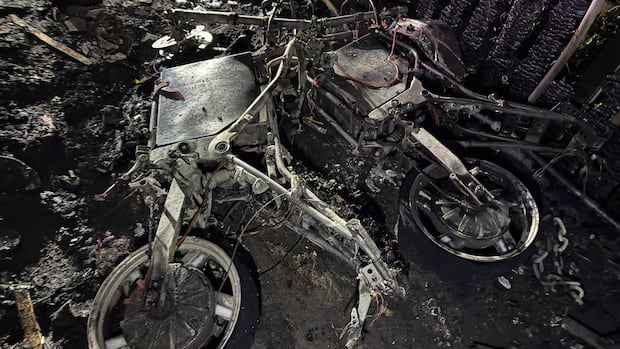
Firefighters are sounding the alarm regarding the dangers posed by rapidly spreading, intense fires originating from lithium batteries in e-bikes within residences (including incidents in Toronto and Peterborough, Ontario this week) as well as large storage batteries at a solar farm in P.E.I. last month.
The rising concerns regarding lithium battery fires have resulted in prohibitions against electric bikes and vehicles in certain buildings, public transit systems, and ferries, creating difficulties for users who depend on them. This has also led to some individuals feeling apprehensive about using electric vehicles.
As we observe Fire Prevention Week this week, the focus is on the risks associated with lithium batteries. Here’s an in-depth look at the challenges posed by lithium battery fires and strategies to mitigate these hazards.
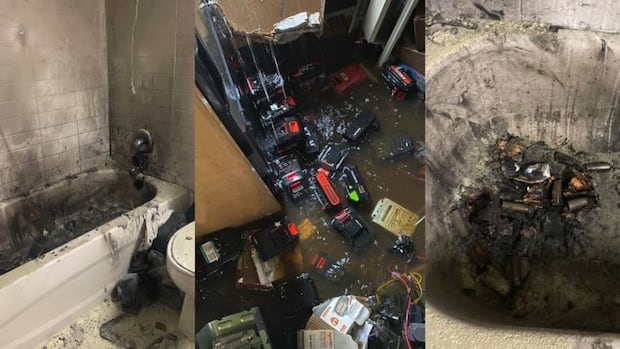
Since 2022, Toronto has experienced an increase of over 200 percent in lithium-ion battery fires, according to the Fire Chief. CBC’s Lane Harrison discusses the factors contributing to this rise and the challenges in extinguishing these fires.
How prevalent are lithium battery fires?
Although Canadian fire departments do not maintain consistent records, a survey conducted by the Canadian Association of Fire Chiefs indicates that around 1,500 fires caused by lithium batteries occurred across 600 communities in the previous year. Paul Boissonneault, the association’s president and chief of the Oakville Fire Department, states that these incidents are escalating rapidly alongside the proliferation of lithium battery-operated devices.
Most lithium battery fires arise from household devices, particularly e-bikes and e-scooters.
In contrast, fires related to electric vehicles and energy storage batteries are significantly rarer, as these systems undergo stringent testing and incorporate safety mechanisms like temperature sensors and cooling systems for battery cells. Although comprehensive statistics on electric vehicle fires in Canada are unavailable, U.S. data suggests they are exceedingly uncommon compared to those involving gasoline-powered cars.

Fires in electric vehicles can be alarming and challenging to manage. However, they are not as frequent as perceived. Misleading information online and a shortage of reliable data can lead to misunderstandings regarding electric vehicle battery fires—firefighters are not exempt from these misconceptions.
Fires stemming from grid storage batteries are even less frequent — a global database from the Electric Power Research Institute indicates that the incident in P.E.I. was one of only six recorded worldwide this year.
What triggers lithium battery fires?
Batteries function by keeping their positive and negative terminals apart, compelling electrons to flow through the device they power to connect the terminals.
A barrier material maintains this separation. When a breach (essentially a short circuit) occurs in this barrier, it can ignite a fire, explained Randy Narine, a firefighter in Brampton, Ontario, who investigates lithium battery safety through his organization Clean Core Research, in a CBC interview.
This breach may develop due to wear over time or from impacts, like dropping a battery from a device, such as an e-bike.
Overheating can also initiate lithium battery fires — resulting from overcharging or incorrect charging (such as using an incompatible charger) or exposure to heat from an outside source, including a fire in another battery cell within the same unit, as many batteries house multiple cells.
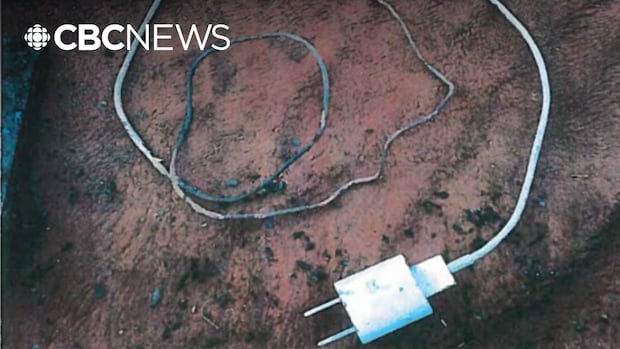
Lithium-ion batteries are utilized in a wide range of devices, from smartphones and tablets to e-bikes and e-scooters. Regina Fire Chief Layne Jackson emphasizes the need to monitor charging devices, as part of the fire prevention measures highlighted by Regina Fire & Protective Services this week.
What distinguishes them from other fires?
They have the potential to burn “hotter and faster” than other types of fires, according to Boissonneault. When lithium batteries reach a certain temperature, they enter a state known as “thermal runaway,” where the heat accelerates chemical reactions within the battery, producing even more heat.
This can result in a “massive chain reaction” and a fire that could potentially explode, Narine warns.
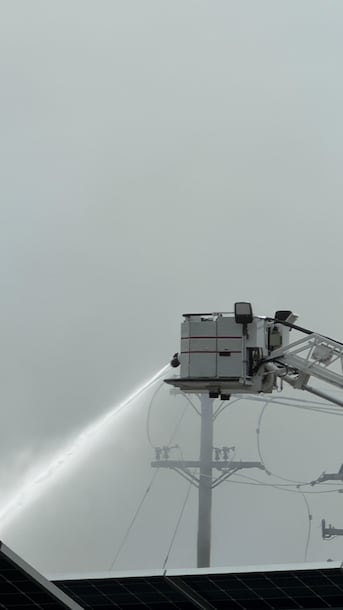
Firefighters indicate that lithium battery fires burn hotter, faster, and are more challenging to extinguish compared to other fire types. So what is required? A substantial volume of water — or perhaps not.
They produce their own oxygen. One of the terminals in the battery consists of a metal oxide that decomposes into metal and oxygen gas during a fire, fueling the fire further. Consequently, conventional methods for extinguishing fires may not be effective.
They emit harmful substances such as hydrogen fluoride as the battery materials disintegrate under heat. These substances can also contaminate the gear and clothing of firefighters with toxins such as formaldehyde and heavy metals that necessitate thorough decontamination afterward.
They have the potential to reignite after hours, days, or even weeks, due to thermal runaway and their ability to generate oxygen. Boissonneault points out that this has significant implications for how damaged batteries are handled and stored post-incident.
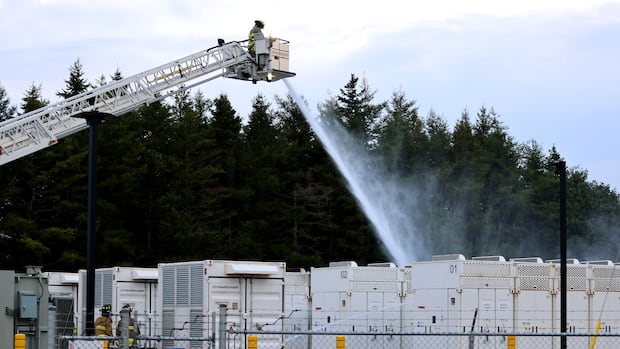
After two weeks of battling a fire at a P.E.I. solar and battery farm, firefighters have finally extinguished it, but officials caution it could reignite. Fires involving batteries are notoriously toxic and difficult to put out.
Firefighters often feel ill-equipped to manage these situations. According to Boissonneault, only 40 percent of surveyed fire departments had formal training for handling lithium battery incidents, with even fewer reporting they had established protocols and the appropriate equipment for such emergencies. Moreover, many departments lack systems to decontaminate their equipment after a lithium battery fire.
How can they be effectively managed and extinguished?
Typically, fires in electric vehicles are doused with substantial amounts of water. Narine estimates that a gasoline vehicle fire can be controlled with less than 2,000 liters of water, while a lithium battery fire may require tens of thousands of liters to extinguish.
Although water can offer cooling and protect adjacent materials from catching fire, it is ineffective in smothering a battery fire.

There has been considerable inquiry regarding the fire that erupted in a battery bank at Summerside’s Sunbank solar farm on September 7. CBC News: Compass host Louise Martin contacted Paul Shoemaker, a lithium-ion battery fire consultant who has trained some firefighters on the Island, to address some of these questions.
In numerous situations, experts assert that it is best to allow the fire to burn itself out.
This is especially true for large energy storage batteries, according to specialists at a fire safety panel during the Energy Storage Canada conference held in Toronto in September.
Adam Jakubowski, a firefighter and senior consultant at Energy Safety Response Group, which focuses on battery energy storage systems, noted that often applying water to a lithium battery fire merely extends the duration of the fire, which might reignite after a week or month. Additionally, this can create water runoff that poses environmental hazards.

Toronto’s Fire Chief Jim Jessop is alerting the public about the increasing threat of lithium-ion battery fires following incidents where crews responded to two battery-related fires within 24 hours this week.