


Josh Wells, a student from Iowa, was eager to visit Montreal on his inaugural trip outside the United States. However, while browsing listings on Airbnb, he started to notice some inconsistencies.
Many of the hosts featured images that Wells believed might have been created using artificial intelligence.
“A typical person taking a picture with an iPhone usually has some imperfections,” Wells explained to CBC’s Cost of Living. “The AI-generated images just appeared too flawless.”
Despite his concerns, Wells continued searching. He was almost ready to reserve one property when a closer inspection of the listing’s images raised additional suspicions.
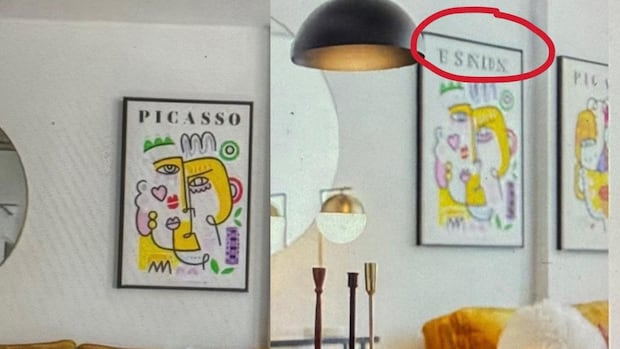
He focused on a piece of wall art that showcased two halves of faces merged together. At the top, the artwork seemed to say “Picasso.” However, in another photo of the same room taken from a different perspective, the artwork looked altered.
“The text appeared all warped and strange,” he remarked. “I thought, ‘Yeah, this is AI.'”

While booking his trip to Montreal, Wells encountered numerous listings featuring remarkably polished images of hosts, which led him to suspect they may have been created by AI. The city has strict regulations for short-term rentals aimed at safeguarding its housing market. (Josh Wells/Reddit)
This was sufficient to deter Wells from that listing — and ultimately from using Airbnb for his trip. Unsure if the photos depicted a genuine property or an AI-generated version, he chose to stay at an apartment-style hotel instead.
“A fake profile picture is one concern, but listings of the actual accommodations where you’ll be spending thousands of dollars was an immediate deal-breaker for me,” Wells stated.
Wells is not alone in questioning the authenticity of images on Airbnb or similar short-term rental platforms.
In July, an Ottawa family reported that upon arriving at their Toronto Airbnb, their daughter discovered a room that looked markedly different from the photos in the listing, which they believed had been manipulated or significantly altered with AI.
The family presented side-by-side images illustrating the discrepancies in the room and bathroom. Airbnb acknowledged that the listing did not correspond with the actual property and issued a refund to the guest, though they did not confirm the involvement of artificial intelligence.
As AI technology simplifies photo alterations, specialists warn that travelers may increasingly struggle to discern whether listings truly represent reality, raising concerns about consumer trust and protection in Canada.
When a photo makeover goes too far
The rise of accessible, user-friendly AI tools is making photo editing more appealing, according to Francis Syms, associate dean in the faculty of applied sciences and technology at Humber Polytechnic in Toronto.
In addition to major AI platforms like ChatGPT, Claude by Anthropic, and Google’s Gemini, numerous websites provide free resources for image editing, according to Syms. For instance, Hugging Face offers thousands of AI tools that allow users to upload and modify images.
“Within just 10 seconds, you can upload a picture to one of these sites and request it to remove all the blemishes or alter the furniture,” he said. “You’ll receive the edited image back in about 30 to 60 seconds.”

Platforms that use artificial intelligence, like ChatGPT, enable users to swiftly and easily modify photos. (Marco Bertorello/AFP via Getty Images)
Determining where AI editing crosses into misrepresentation is challenging, said Daniel Guttentag, an associate professor of hospitality and tourism management at the College of Charleston in South Carolina.
“If you digitally add a fake hot tub on the back patio, most people would agree that is a clear misrepresentation of what the unit offers,” he stated. “But if you merely adjust the lighting a bit … most people might be fine with that.”
“Yet there is significant ambiguity in between, where it crosses into ‘Hold on, this isn’t what I was expecting.'”
Guttentag also raised concerns regarding the use of AI-edited images to falsely suggest that guests have caused damage to a property, which could lead to compensation claims.
In 2025, a guest from London, U.K., booked an Airbnb in Manhattan and was accused of inflicting over £12,000 ($22,665) in damages.
She contested the claim after observing discrepancies in the images of a purportedly cracked coffee table, which she believed had been digitally altered or created by AI.
Initially, Airbnb claimed she owed over £5,000 ($9,444) but later fully reimbursed her after the case attracted media coverage.
Can you trust what you see online?
Trust plays a crucial role for Airbnb users who rely on images to choose which property to book, according to Guttentag.
“You can’t test it out beforehand, like a pair of shoes,” he pointed out. “You need to have faith and trust that it will meet your expectations.”
While AI-enhanced photos might help hosts secure bookings in the short term, guests who arrive to find a different reality may leave unfavorable reviews, Guttentag noted. If individuals feel misled “one too many times,” he warned, it could lead them to abandon the platform entirely.

Daniel Guttentag is an associate professor of hospitality and tourism management at the College of Charleston in South Carolina, with a focus on research regarding Airbnb and artificial intelligence. (Submitted by Daniel Guttentag)
In a statement to CBC News, Airbnb affirmed that its policies mandate that listings be “accurately depicted” and that the company may require hosts to eliminate content that employs AI or other digital technologies to “edit defects, conceal damage, add amenities or features that are not part of a listing, or otherwise materially misrepresent the listing.”
The company also encouraged guests to report deceptive listings, stating that those who encounter a property that does not match its description can reach out to its 24/7 community support team. Under AirCover, Airbnb mentioned that it might assist guests in finding a similar accommodation or provide a refund if the host is unable to resolve the issue.
In August, California’s Artificial Intelligence Transparency Act (CAITA) became effective, mandating that AI-generated images, videos, and audio must include information that aids consumers in determining whether digital content was created or modified using AI.
A figurine in front of the logo of the AI assistant “Claude,” developed by the U.S. artificial intelligence safety and research company Anthropic during a photo session in Paris on February 13, 2026. (Joel Saget/AFP via Getty Images)
Currently, Canada lacks specific legislation addressing deceptive advertising related to AI, according to Steve Szentesi, a competition and advertising lawyer based in Toronto. However, he noted that existing laws can still apply to misleading AI-generated images.
The federal Competition Act prohibits misleading advertising, whether the claims are presented through text, images, audio, or other media forms. Additionally, provincial and territorial consumer protection laws offer comparable safeguards.
While AI-generated images are a relatively recent phenomenon, the fundamental issue is not new, Szentesi pointed out. Courts have dealt with disputes over real estate listings for many years, including situations where images of a property did not correspond with the actual home or contradicted descriptions in the listing.
For consumers who suspect that a short-term rental listing misrepresents a property, Szentesi advises first addressing the issue with the rental platform. They can also lodge a complaint with the Competition Bureau or their respective provincial or territorial consumer protection agency.
-
AI ‘slop’ is dominating menus, as some restaurant owners turn to it to save time and money
-
Can I get AI face? Plastic surgeons say AI-generated inspiration is more than meets the eye
In the meantime, Syms recommends potential bookers look for signs of AI-generated images in listing photos, such as misaligned door frames, tile lines and countertops, oddly shaped furniture, inconsistent shadows or reflections, and unclear or distorted text on books or wall art.
Travelers can also utilize a tool like Google Lens to search for the same image online to determine if it has been sourced from another website rather than accurately portraying the property.
For Wells, this experience has not deterred him from using Airbnb entirely — he had a satisfactory experience booking through the platform in Kansas City last March. However, his search for accommodations in Montreal has made him more cautious moving forward.
“I am willing to consider it again as long as there are no fake AI listings,” he concluded.