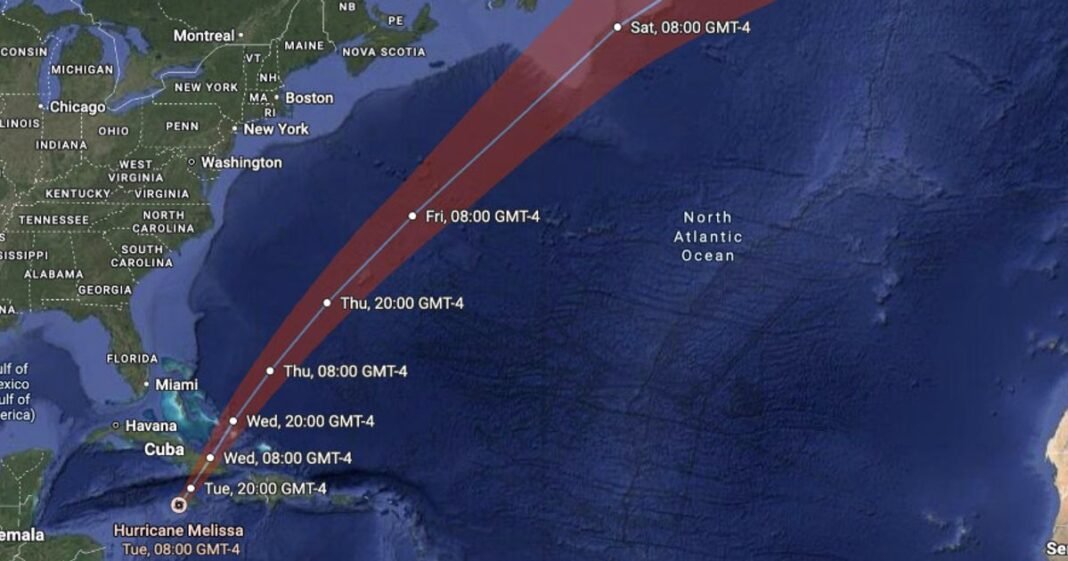

A powerful storm named Hurricane Melissa, the most intense one this year, is approaching Jamaica, as indicated by the National Hurricane Center. This Category 5 hurricane, with sustained winds reaching 175mph, is currently causing flash floods and storm surges on the Caribbean island. While still some distance away, the storm is accelerating, with its center expected to hit land around midday local time. Meteorologists predict that Melissa could become the most severe hurricane to strike Jamaica, bringing heavy rainfall of up to 30 inches and wind speeds of 175mph.
The Met Office has raised concerns that Hurricane Melissa might impact the weather in the UK. A spokesperson mentioned to Yahoo News UK that the storm is likely to lose its tropical characteristics over the North Atlantic and eventually dissipate later in the week. There is a slight possibility that the remnants of Melissa could influence the UK weather next week, but any significant disruptions are currently deemed improbable. Nevertheless, the storm could contribute to the prevailing unsettled conditions affecting the UK.
Following its impact on Jamaica, Melissa is anticipated to head towards eastern Cuba by Tuesday evening, where over 500,000 individuals have been evacuated from vulnerable regions. By Wednesday evening, the storm is projected to move towards the Bahamas, possibly weakening to a Category 2 hurricane by then.
Melissa has already resulted in three fatalities in Jamaica and four in Haiti and the Dominican Republic. The International Federation of Red Cross and Red Crescent Societies estimates that up to 1.5 million people in Jamaica could be affected by the storm, with around 25,000 tourists currently on the island.
Michael Brennan, the director of the US National Hurricane Center, warned of the severe impact of the storm, emphasizing the potential for “total building failures” and wind gusts of up to 200mph in Jamaica’s highest mountains. Prime Minister Andrew Holness of Jamaica cautioned that the country’s infrastructure may not withstand the storm’s conditions.
Climate experts attribute the intensification of Caribbean hurricanes to the climate crisis. Research from Climate Central reveals that Melissa rapidly strengthened while lingering over ocean waters 1.4°C warmer than average, conditions that are significantly influenced by climate change.
The storm was named Melissa in accordance with the naming system for tropical storms established by the US National Hurricane Center and the World Meteorological Organization. These names follow a six-year cycle and are only retired if a storm causes extreme devastation.