

Observing from the deck of a Finnish patrol ship, I witnessed armed individuals descending from a helicopter and launching an assault on the vessel.
The masked security personnel swiftly advanced to the ship’s bridge, loudly commanding authority. Fortunately, this was merely a training exercise conducted by the Finnish Border Guard, tasked with safeguarding an 830-mile border along NATO’s eastern boundary, directly facing Russia. Beyond border control, this force actively engages with suspicious activities in the Gulf of Finland, including intercepting vessels suspected of disrupting vital undersea cables.
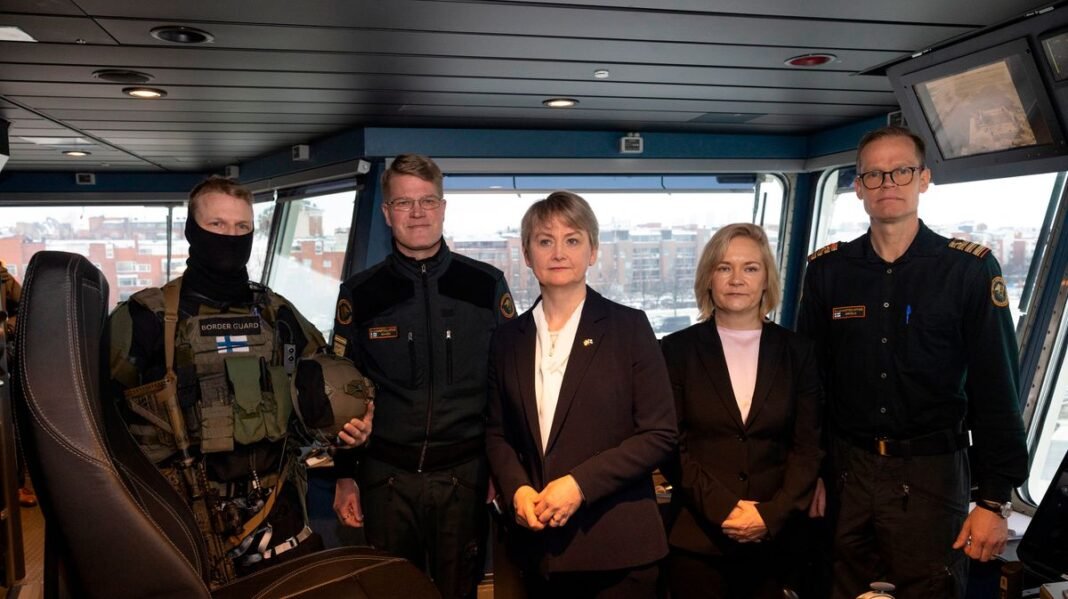
Demonstrating the procedure for seizing control of a suspected vessel, camouflaged personnel showcased their tactics to Foreign Secretary Yvette Cooper during her recent visit to Finland and Norway. During our inspection aboard the Turva, an offshore patrol vessel in Helsinki overlooking the Gulf of Finland, the proximity to Russia, extending to St. Petersburg, felt remarkably close.
Given Russia’s close proximity, Finland confronts challenges posed by Putin’s disruptive strategies and unconventional warfare. The visit by Ms. Cooper underscored the significant threat posed by the Russian shadow fleet to the UK.
In an interview, Ms. Cooper emphasized the necessity for decisive actions to combat the network of aging oil tankers operating under dubious flags. These tankers not only evade Western sanctions, indirectly funding Putin’s activities in Ukraine but are also implicated in sabotaging critical undersea cables vital for telecommunications and energy supplies like electricity, oil, and gas.
Reports suggest that the UK is exploring the legal avenues for potential military interventions to board such vessels, following its recent support to US special forces in a notable operation targeting a tanker linked to Russia. The Foreign Secretary’s trip coincides with escalating tensions concerning the Arctic region.
The warming seas due to climate change have triggered geopolitical dynamics as new maritime routes open up and resources become accessible with melting ice. The geopolitical significance of Greenland, amid speculations of annexation by the US, has elevated the Arctic issue on the global agenda.
Britain aims to demonstrate its pivotal role alongside NATO allies in shaping security policies for the Arctic region. However, the potential actions of the US President could significantly impact this strategic alignment.