

Plant enthusiast Klaus Koehler made an intriguing discovery while exploring Sylvia Grinnell Territorial Park near Iqaluit in July. He stumbled upon a rarely seen species in the Arctic, suggesting potential implications for invasive species in Northern regions amid climate change.
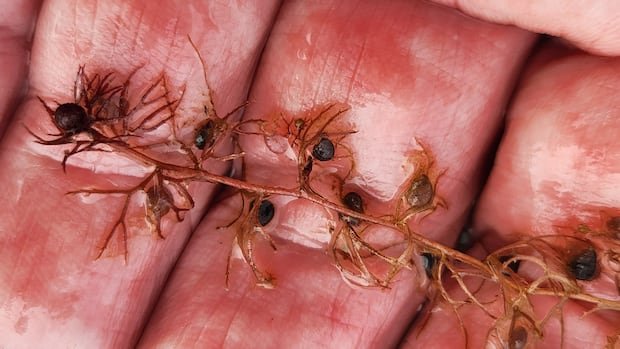
Koehler encountered a peculiar brownish plant known as bladderwort when he reached into a pond. While unremarkable at first glance, this carnivorous plant is adorned with small black balls called bladders containing partially digested flies. Typically found in more southern areas, bladderwort seldom ventures into the tundra.
Notably, the only prior documentation of this plant in the vicinity dates back to 2012 when scientists located samples of bladderwort near Kimmirut, approximately 120 kilometers southwest of Iqaluit. This discovery was documented in the scientific journal Phytokeys.
During three research expeditions to the Arctic, that same team identified over 30 new plant species in the region’s archipelago.
Koehler speculates that this finding may signal a shift in the climate. Although the Arctic currently hosts few invasive species due to the harsh environment, warming temperatures are fostering a more hospitable setting for atypical plant species to thrive in the area. This transition is expected to impact the local ecosystem significantly.
Paul Sokoloff, a senior research assistant at the Museum of Nature in Ottawa and a member of the 2012 research team, shares Koehler’s concerns. He highlights the potential risks associated with new plant species migrating to northern ecosystems, facilitated by birds, cargo ships, and human visitors.
While Sokoloff believes Koehler’s discovery may not pose an immediate threat, he emphasizes the vulnerability of Arctic flora to invasive species. With over 2,500 plant species capable of invading the Arctic, the delicate balance of native vegetation faces potential disruption due to climate change.
Koehler intends to send a sample of the bladderwort he found in Iqaluit to the Museum of Nature for further analysis, aiming to deepen scientists’ understanding of the plant’s expansion towards the north.