
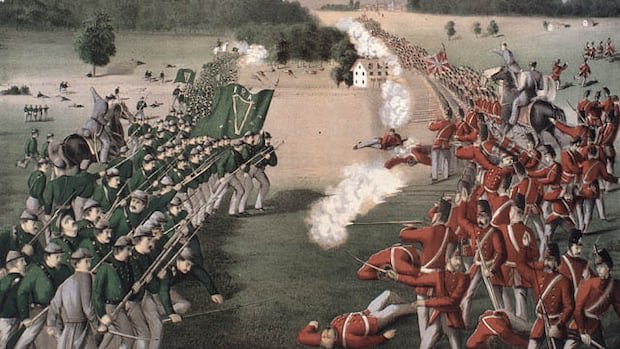

An overlooked clash on Canadian terrain just before Confederation, known as the Battle of Ridgeway or Limestone Ridge in 1866, holds significant historical importance despite its limited recognition. This battle marked the first instance of Canadian troops led by Canadian officers engaging in combat. Additionally, it served as the foundation for Decoration Day, a precursor to Remembrance Day, observed annually in certain regions of Canada.
Even though the nine individuals who lost their lives in this battle are not included in the Books of Remembrance on Parliament Hill, efforts are underway to rectify this oversight. A petition, spearheaded by Conservative MP Fred Davies, aims to have these fallen soldiers, along with the numerous casualties ensuing the battle, officially recognized by adding their names to the memorial list.
The Battle of Ridgeway, unlike a clear victory for Canada, witnessed inexperienced volunteers confronting seasoned Fenian raiders, predominantly veterans of the American Civil War. The Fenian Brotherhood, an Irish American movement striving for Irish independence from British rule, attempted to achieve their goal by invading and holding parts of British North America for ransom.
In response to the Fenian incursion in 1866, around 800 Canadian volunteers from various regiments engaged hundreds of raiders at Limestone Ridge near Ridgeway and Fort Erie. Despite facing challenges such as inadequate supplies and lack of preparation, the Canadian troops engaged the invaders, leading to a battlefield defeat but ultimately forcing the Fenians to retreat back to the U.S. side of the Niagara River.
The sacrifice of those who perished in the Battle of Ridgeway is not diminished by the military setback. While recognizing the battle as a pivotal moment in Canada’s history, advocates emphasize the bravery and dedication of those who fought to protect their homeland against foreign invaders.
A memorial honoring the nine fallen soldiers from Ridgeway was unveiled in 2016, commemorating the 150th anniversary of the battle. Calls for formal recognition in the Books of Remembrance have been ongoing, with local officials and historians highlighting the battle’s significance in shaping Canadian identity and the formation of the country.
The Battle of Ridgeway, although predating the establishment of Canada, is viewed as a crucial event that influenced Confederation. It rallied support for the idea of a unified nation among those who were initially hesitant, solidifying Canada’s identity both symbolically and practically.
Several regiments that participated in the 1866 battle, such as the Queen’s Own Rifles and the Royal Hamilton Light Infantry, continue to exist today, testifying to the enduring legacy of this historic conflict. Notably, Alexander Muir, composer of “The Maple Leaf Forever,” drew inspiration from his experience at Ridgeway, underscoring the battle’s role in fostering a sense of Canadian patriotism and allegiance.
In essence, the Battle of Ridgeway serves as a testament to the early struggles and sacrifices made by Canadians in defense of their homeland, laying the foundation for a cohesive national identity rooted in pride and resilience.