
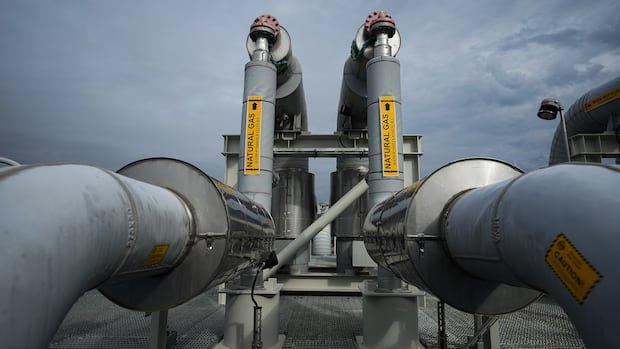

Prime Minister Mark Carney emphasizes the significant role of Canada in fueling American economic growth, particularly through the export of natural gas to the United States. The potential implications of halting these shipments raise questions about the impact on both countries.
Despite the ongoing trade tensions between Canada and the U.S., energy products like oil and natural gas have not been utilized as bargaining tools. This approach has sparked differing opinions among Canadian leaders, with Alberta Premier Danielle Smith opposing the idea while Ontario’s Doug Ford advocates for keeping all options open.
Carney highlighted that the U.S. heavily relies on Canada for energy sources, supplying a substantial portion of their natural gas, electricity, and crude oil imports. While the U.S. is a major importer of Canadian natural gas, accounting for almost all non-domestic supply according to the U.S. Energy Information Administration, it represents only a small fraction of total U.S. gas consumption.
Dulles Wang, the director of Americas gas and LNG at Wood Mackenzie, mentioned that Canadian natural gas shipments to the U.S. constitute a relatively minor percentage of American domestic production. However, the locations where these deliveries occur play a crucial role in the energy trade dynamics between the two countries.
Enbridge, headquartered in Calgary, stands as the largest natural gas provider in North America. The company’s strategic acquisitions in the U.S. utilities sector underline its significant presence in the energy market.
The intricate network of natural gas pipelines crisscrossing North America facilitates the constant flow of gas between Canada and the U.S. Wang emphasized the bidirectional nature of this trade, with the U.S. exporting gas to Canada while importing supplies for different regional markets.
The potential disruption of natural gas shipments from Canada to the U.S. could have adverse effects on both countries. Wang warned that such a halt could lead to oversupply within Canada, causing a sharp decline in prices and negatively impacting the industry.
Canada aims to diversify its energy export markets beyond the U.S., with recent efforts to send liquefied natural gas to Asian markets from facilities like the LNG Canada plant in Kitimat, B.C. The government’s support for new energy projects reflects a strategic shift towards reducing dependence on the U.S. market and exploring alternative opportunities for export growth.