
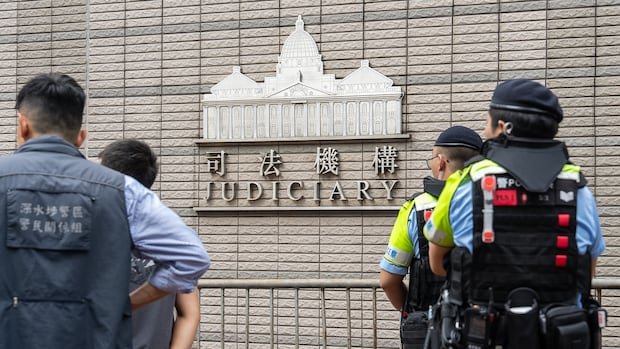

Two individuals who previously organized Hong Kong’s traditional vigil commemorating the 1989 Tiananmen Square crackdown were found guilty in a national security case on Friday. The case was brought under a law imposed by China, which has effectively subdued Hong Kong’s once-vibrant pro-democracy movement.
Lee Cheuk-yan and Chow Hang-tung, former leaders of the Hong Kong Alliance in Support of Patriotic Democratic Movements of China, were charged in 2021 with inciting subversion under the national security law. Despite pleading not guilty, they now face a maximum prison sentence of 10 years. The alliance itself was also convicted.
According to the three judges presiding over the case, the alliance’s advocacy to “end one-party dictatorship” was interpreted as seeking to remove the ruling Communist Party from its leadership position under the constitution, rather than advocating for a return to a multiparty cooperation system. The judges emphasized that the term “end” in this context implied “overthrowing” and “undermining.”
The judges noted that the defendants continued to promote this message even after the introduction of the security law, disregarding that it contradicted the constitution, which identifies the party’s leadership as a fundamental aspect of socialism with Chinese characteristics. This act was deemed as falling under “other unlawful means” within the national security law.
This verdict is part of a series of legal actions targeting Hong Kong’s pro-democracy movement, which has significantly declined due to interventions by Hong Kong and Chinese authorities.
The annual candlelight vigil organized by the alliance had been a major public event for three decades, attracting tens of thousands of attendees to honor the victims of the Tiananmen Square tragedy in China. The vigil was prohibited in 2020 amid the COVID-19 pandemic and shortly before the implementation of the security law by Beijing to suppress the 2019 anti-government protests.
Lee and Chow, who smiled and waved at the public gallery as they left the courtroom, are awaiting sentencing. They are set to request leniency in the following week. Observers view their trial as a symbol of diminishing freedom of expression in the territory, which reverted to Chinese control in 1997.
The judges did not provide the rationale behind the conviction during the court session, mentioning that the full judgment would be accessible online later.
Eric Lai, a senior fellow at the Georgetown Center for Asian Law, highlighted that the charge of inciting subversion is commonly used in mainland China to criminalize the actions of human rights advocates, activists, and intellectuals. He expressed concerns about the alignment of Hong Kong’s judicial system with the mainland’s party-led judiciary based on the criminal verdict.
During the trial, prosecutors argued that the case was not politically motivated but focused on the alliance’s alleged incitement to overthrow the ruling Communist Party through unlawful means, citing their call to “end one-party rule.” In contrast, Lee and Chow maintained that their intention was to advocate for democracy and not to challenge the party’s leadership.
Chow, who represented herself in court, explained that “ending one-party rule” meant putting an end to unchecked power, criticizing the inversion of moral standards in the case.
The trial, initially scheduled for 75 days, concluded its closing arguments much earlier, after 24 days. Albert Ho, another defendant in the case, had previously pleaded guilty, a move that could potentially lead to a reduced sentence.
Following the conviction, Lee’s wife expressed disappointment and frustration, asserting Lee’s innocence and criticizing the judicial process. Supporters gathered outside the court, with some expressing doubts about the allegations against the alliance and its members.
The crackdown on the pro-democracy movement in Hong Kong has led to the dissolution of several civil society groups, including the Hong Kong Alliance in Support of Patriotic Democratic Movements of China, as authorities tightened control over the region.