
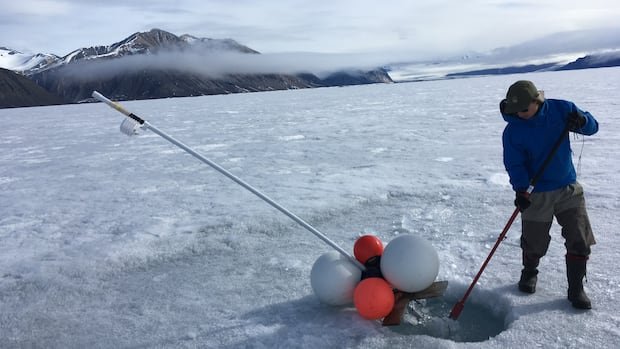

A recent study has confirmed the disappearance of Canada’s last remaining epishelf lake, which was a unique ecosystem on Ellesmere Island in Nunavut. Lead author Jérémie Bonneau, an assistant professor at Laval University, expressed sadness over the loss, noting that it was the only one of its kind in Canada.
The study, published in the journal Scientific Reports, detailed the process through which the Milne Fiord epishelf lake vanished, marking the end of a 4000-year era. This event underscores the impact of climate change on the Arctic region.
Epishelf lakes form when freshwater accumulates on top of saltwater due to natural barriers like the Milne Ice Shelf. The lake had been in existence for over 4,000 years, with a significant freshwater layer that was 18 meters deep in 1983.
The unique ecosystem within the lake consisted of distinct communities of bacteria, viruses, and phytoplankton in the freshwater and saltwater layers. The disappearance of the lake following the collapse of the Milne Ice Shelf in 2020 led to the immediate mixing of freshwater and seawater, resulting in the loss of freshwater organisms.
The study highlighted the importance of such ecosystems and the irreversible changes caused by environmental factors. While epishelf lakes are no longer found in Canada, a few still exist in Greenland and Antarctica, though their future remains uncertain. This serves as a reminder of the fragility of Earth’s diverse ecosystems.