
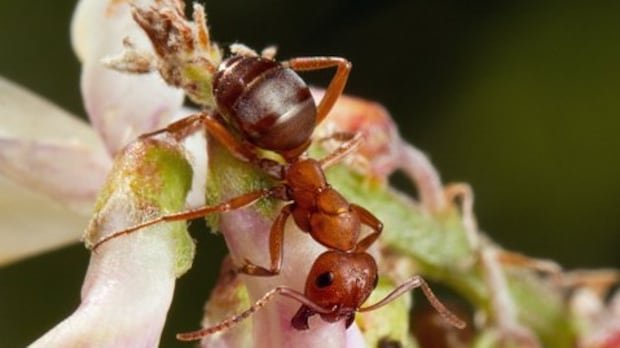

In the southeastern part of Alberta, the Cypress Hills stand out as a striking feature amidst the flat prairie landscape. Beneath this scenic view, a fascinating natural drama unfolds. Ants in Cypress Hills Provincial Park cling to plants and shrubs, awaiting the chance to be unwittingly consumed by herbivores. This peculiar behavior is orchestrated by the parasite Dicrocoelium dendriticum, known for its remarkable ability to manipulate its host like a zombie.
Researchers from the University of Calgary and University of Lethbridge have hailed this parasite as a standout in the world of parasitic manipulations. Unlike other zombie-like parasites, Dicrocoelium dendriticum possesses the unique capability to switch its control over its host on and off.
Zombie parasites are a common occurrence in nature, as noted by Cameron Goater, a parasitologist and professor emeritus at the University of Lethbridge. These parasites often manipulate their hosts to facilitate their transmission to other hosts. For example, the Cordyceps fungus compels infected ants to climb plants and die, enabling the fungus to spread its spores. Similarly, the horsehair worm drives crickets to commit suicide by jumping into water for the worms to reproduce.
Unlike most parasitic manipulations that lead to the host’s death, Dicrocoelium dendriticum incentivizes keeping the host alive due to its complex life cycle involving multiple hosts. The adult worms of this parasite reside in the livers of grazing mammals such as elk, deer, or cattle. The parasite’s eggs are excreted in the host’s feces, consumed by snails, and eventually ingested by ants, where the intricate cycle continues.
The challenge for the parasite lies in ensuring that the ants are consumed by grazing mammals, as these hosts typically avoid consuming ants. To overcome this, Dicrocoelium dendriticum manipulates the ants to climb plants where they are more likely to be accidentally ingested.
This strategy poses risks for the ants, as clinging to vegetation exposes them to predators and dehydration. However, the parasite incorporates an “on-off switch,” allowing the ants to detach from plants and return to their nest when necessary. These manipulated ants exhibit this behavior as long as the temperature remains below a certain threshold.
The ability of the parasite to influence the behavior of the host raises intriguing questions about the underlying mechanisms. Researchers are delving into the genetic and biochemical changes occurring in the infected ants to unravel the complexities of this parasitic manipulation.
Dicrocoelium dendriticum offers valuable insights into the consequences of human interactions with nature. Introduced to Canada likely through the importation of livestock from Europe, this parasite thrives in Cypress Hills due to human-influenced factors such as fire control and cattle grazing practices. Understanding how these conditions favor the parasite’s survival can shed light on managing emerging diseases and their ecological impacts.
In conclusion, the intricate relationship between Dicrocoelium dendriticum and its hosts in Cypress Hills serves as a captivating example of nature’s intricate and sometimes mysterious workings.