
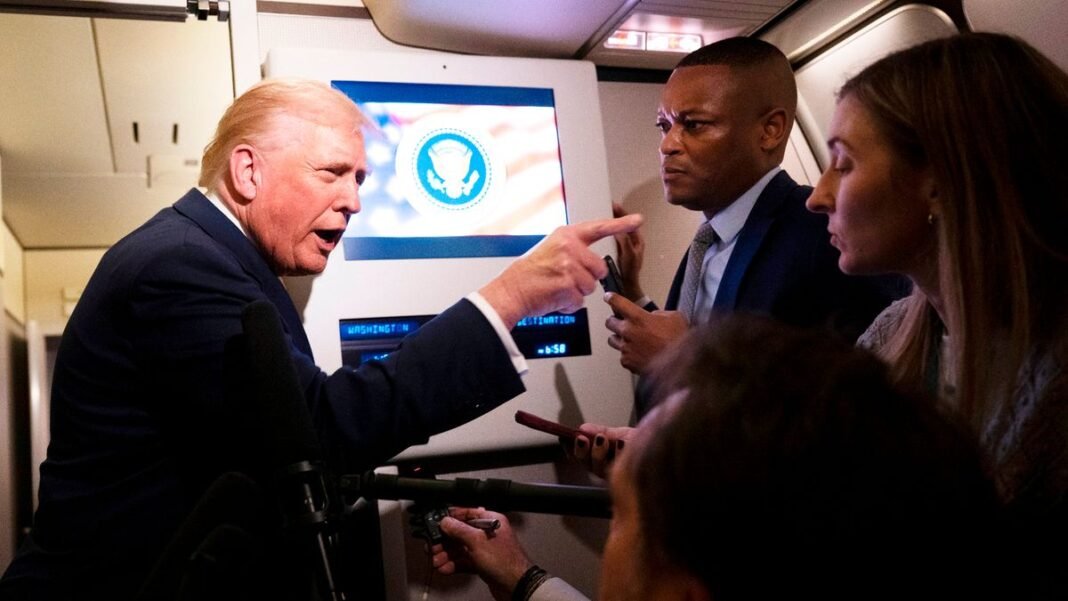

In a recent incident, President Donald Trump made derogatory remarks towards a journalist, sparking outrage among many. The journalist, Catherine Lucey, confronted Trump about his connection to the Epstein files while aboard Air Force One en-route to Washington. Trump responded by aggressively silencing her, calling her a “piggy” in a widely circulated video clip.
Experts suggest that Trump’s behavior is not merely impulsive but rather a calculated display of power dynamics ingrained in his psyche. Psychologist Alex Iszatt highlights Trump’s upbringing in a milieu of misogyny and elitism, shaping his views on women as objects of power and status rather than individuals with intellect and agency.
Moreover, Trump’s pattern of objectifying and demeaning women dates back to his days as a reality TV personality. From making lewd comments about women to publicly sexualizing his own daughter, Ivanka, Trump has consistently displayed a troubling attitude towards women, treating them either as trophies for validation or tools for manipulation.
Body language expert Judi James notes that Trump’s insults are often visually driven, reflecting his fixation on outward appearances. His tendency to reduce women to their physical attributes aligns with his perception of beauty as the ultimate form of praise and insult.
Despite these behaviors, analysts believe that Trump’s use of personal insults signifies a sense of insecurity rather than strength. Resorting to name-calling and derogatory remarks is viewed as a sign of immaturity and a lack of control, indicating a diminishing grasp on power rather than a display of dominance.
In essence, Trump’s verbal attacks on women and his aggressive demeanor are seen as strategic maneuvers to assert authority and project an image of strength. However, beneath the facade lies a complex interplay of ego-centricity, lack of empathy, and a deep-rooted need for control, all contributing to his controversial behavior.