
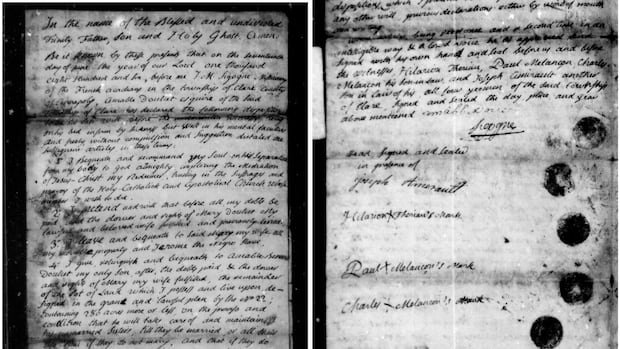

Hilarion Thériault, a 71-year-old Acadian, made a rare decision to create a will in the 19th century, a time when many Acadians lacked significant property due to historical events like the Acadian deportation. Despite challenges in land ownership and property rights, Thériault, unlike many others, wanted to ensure his affairs were in order before his passing.
Colby Gaudet, a post-doctoral fellow at Dalhousie University, delved into Thériault’s will and 23 others from the small Acadian community of Clare, N.S., to examine how families navigated legal and religious customs related to death and mourning. Gaudet highlighted the dual nature of these wills as acts of both resistance and compliance, reflecting the Acadians’ adherence to Catholicism in a predominantly Protestant legal system.
Thériault’s will included requests for debt repayment, reparations, and provisions for his family’s peace. Maurice Basque, a historian at l’Institut d’études acadiennes at the Université de Moncton, emphasized the social ostracism faced by Acadians during that era, stemming from events like the forced Acadian deportation in 1755.
Gaudet noted the linguistic challenges faced by Acadians when creating wills, as all county judges overseeing such documents were Anglo-Protestant. The wills were predominantly written by a priest named Jean-Mandé Sigogne, who acted as an intermediary between the Acadian families and the judicial system, having fled France during the French Revolution.
The wills studied by Gaudet were primarily left by community leaders deeply rooted in Catholicism, reflecting their unwavering faith in their wills despite societal stigmatization. These wills often included distinct Catholic elements, such as references to saints and the Virgin Mary, reinforcing their religious identities in the face of societal pressures.
Gaudet’s research on Acadian wills also shed light on the relationships between Acadians and Black individuals in the community. For instance, Amable Doucet’s will mentioned passing a Black slave named Jerome to his wife alongside his property, revealing complex dynamics within the community.
The study of these historical wills not only provides insights into Acadian culture and legal practices but also underscores the resilience and faith of these communities in preserving their heritage amidst challenging circumstances.