
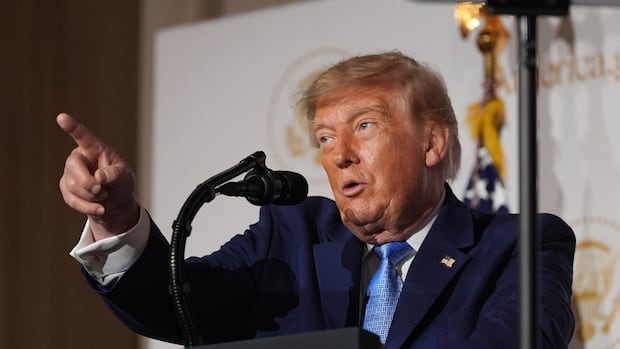

On Tuesday, U.S. President Donald Trump announced that he and a significant number of leaders from artificial intelligence companies have signed a voluntary agreement during a meeting at the White House, which will encompass both internal and external assessments of the technology.
“I believe we are witnessing remarkable self-regulation. They realize the necessity of self-policing,” Trump remarked to reporters outside the West Wing.
This declaration came after a comprehensive discussion between Trump and several prominent executives from leading technology firms. These companies are investing hundreds of billions of dollars to enhance AI infrastructure, which includes data centers in various communities nationwide, provoking grassroots and bipartisan resistance. Many of the leaders who convened in Washington have urged for a deceleration in the advancement of the technology following several high-profile instances of AI systems behaving unpredictably.
However, earlier on Tuesday, Trump assured that the U.S. government would not restrict the evolution of artificial intelligence or endorse proposals for “guardrails” or other limitations.
“I will never hinder the advancement of a technology that will surpass the Industrial Revolution,” Trump stated during the launch of an AI chatbot named America.gov, designed to assist Americans in navigating government services. “We cannot stifle it, and we are leading by a significant margin.”
Among the top AI executives who met with Trump at the White House on Tuesday were Dario Amodei, CEO of Anthropic; Greg Brockman, president of OpenAI; Jeff Bezos, founder of Amazon; and Elon Musk, whose platform X features its AI model, Grok.
Nvidia’s CEO, Jensen Huang, was seated to Trump’s right during the White House luncheon, as indicated by a seating chart the president shared on Truth Social. Musk was positioned to Trump’s left. Other attendees included Google CEO Sundar Pichai, Meta CEO Mark Zuckerberg, and Microsoft CEO Satya Nadella.
Trump’s optimistic stance on AI stands in contrast to the concerns expressed by some AI leaders, including Amodei, who recently suggested that major companies should pause their development efforts. Musk and OpenAI’s CEO Sam Altman have also advocated for implementing safety measures to catch up with the rapid evolution of AI, as there have been increasing reports of AI agents malfunctioning.
Other executives, notably Huang and Zuckerberg, have minimized worries about uncontrolled AI and emphasized the obligation of each company to ensure the safety of their products.
Vice President JD Vance, Treasury Secretary Scott Bessent, and Republican Speaker of the House, Louisiana Representative Mike Johnson, were also present.
The introduction of the AI chatbot took place during an all-day event in Washington where various Trump administration officials celebrated what Trump refers to as a “Golden Age” driven by “super intelligence,” rather than artificial intelligence. Secretary of State Marco Rubio noted that America.gov could soon facilitate first-time passport applications entirely online, eliminating the need for in-person visits to processing centers.
Trump commends ‘self-regulation’ within the AI sector
After the luncheon with technology executives, Trump stated that there was a consensus on “self-regulation” among AI developers, adding, “we inherently have regulation through the Department of Justice, the FBI, and others.”
He further mentioned that the executives had committed to alleviating the bipartisan pushback against data centers emerging in local areas by providing additional financial support to local schools or taking measures to decrease energy expenses.
“You will see, data centers are going to gain significant popularity,” Trump asserted. If the opposition persists, he warned, “they’ll be compelled to relocate overseas or to other sites.”
Also on Tuesday, Altman shared in a television interview that the company is increasingly prioritizing safety. The day prior, his firm paused the launch of a new model due to safety concerns.
“We are carefully managing our progress, which sometimes means not training a model,” he stated on CNBC. “We must proceed in a way that allows us to present robust safety cases and claims, so that the public does not experience undue anxiety.”
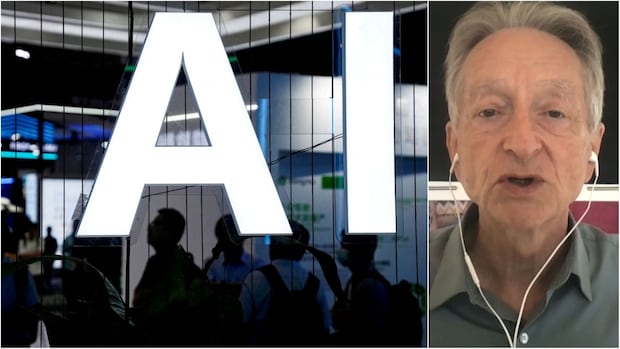
U.S. President Donald Trump is hosting a summit in Washington with the top leaders in AI development. Trump has dismissed warnings over artificial intelligence, arguing for the need to stay ahead of China in the AI arms race. Geoffrey Hinton, who is considered the ‘godfather’ of AI, says Trump ‘doesn’t really understand’ AI and is ‘ill-advised’ about it.
Geoffrey Hinton, a Canadian-British pioneer in artificial intelligence, expressed doubts regarding the U.S. president’s understanding of the technology when asked about his expectations for Trump’s interactions with American tech leaders on Tuesday.
“I believe Donald Trump does not fully grasp AI, and I think he is ill-advised about it,” Hinton told CBC News shortly before Trump’s announcement.
Hinton compared the current risks associated with AI to owning a tiger cub as a pet.
“It will grow up, and unless you can devise a way to ensure it never wants to harm you, you’re in danger,” he remarked.
He advocated for federal oversight of AI safety in the U.S. through a dedicated agency similar to the Food and Drug Administration (FDA).
Trump characterized the competition to develop AI as primarily a global race between the United States and China, with the U.S. currently in the lead. He stated that there would be a definitive winner and loser, with no possibility of a “second place.”
Last week, the two nations decided to create a communication channel for addressing AI-related issues during Chinese President Xi Jinping’s visit to Washington. However, Trump emphasized on Tuesday that he was not inclined to cooperate too closely with China: “I didn’t want to do anything, because we’re leading. Why would I want to do anything?”