
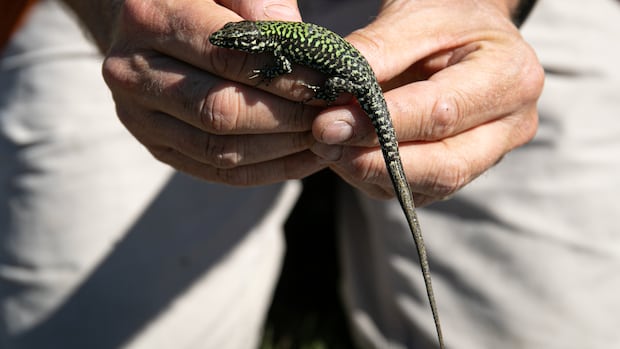

Tracy Menzies had been battling slugs in her backyard garden, as they consistently outpaced her during harvest time, but this year proved different.
The strawberries in her garden have turned out to be “truly stunning” this season.
It appears that the slugs are up against a tough opponent — the invasive European wall lizard, which specialists report is rapidly proliferating and consuming a wide range of creatures, from insects and spiders to slugs.
Living near the Gorge Waterway in Saanich, Menzies mentioned that she began to observe an increasing number of lizards in her yard a few months ago, darting around her garden and scurrying beneath her feet.
“I haven’t seen a slug in my yard, so I can only presume, given the recent sightings of the wall lizards, that they are enjoying a meal of slugs,” Menzies stated.
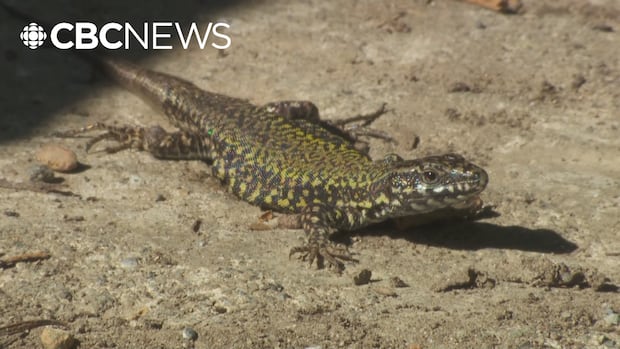
Most of the lizards she has seen are just a few inches long, with many being even smaller.
“However, in North Saanich, I’ve spotted some that are at least eight to ten inches long, and I’ve even encountered them in crawl spaces,” Menzies, who works as a real estate agent, noted.
Gavin Hanke, curator of vertebrate zoology at the Royal B.C. Museum, estimates that there are between 800,000 to a million European wall lizards in British Columbia — primarily located on Vancouver Island — and they have expanded their territory as far north as Campbell River, which is 220 kilometers from Victoria.
He expresses concern that their swift expansion may pose a “serious threat” to the environment.
“They are spreading rapidly, and we are left to deal with their presence,” Hanke remarked. “We will have to adapt to coexisting with them.”
“The unfortunate aspect is that these lizards are affecting invertebrate populations. They do prey on young garter snakes. Each lizard consuming something daily significantly impacts the insect and spider populations on Vancouver Island,” he added.
-
No plan in place to control invasive American bullfrogs in Stanley Park
-
Comox Valley residents come together to halt spread of invasive American bullfrog
Biologist Nicholas Wong, who is the science and operations manager with the Invasive Species Council of B.C., stated that there are currently no formal management programs in place to control the population growth.
Wong explained that the lizards are “competing with some of our native lizard species for food and habitat as well.”
Hanke, a Victoria resident, indicated that the lizards first appeared in his garden around 2019, when he noticed a few, but their numbers have since exploded to about 100 thriving in both his front and back yards.
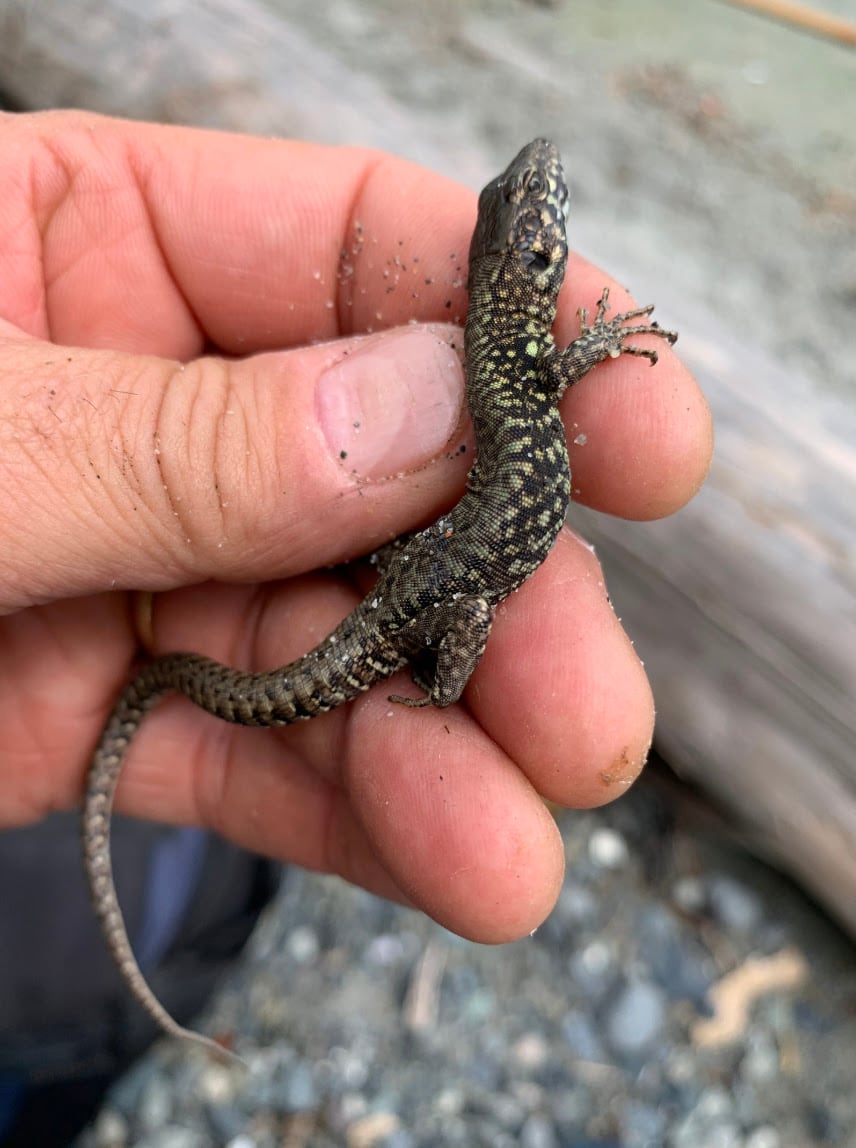
A European wall lizard is depicted in this undated image. The population has surged on Vancouver Island following a minor release from a private Saanich zoo in 1967. (Handout by Gavin Hanke/The Canadian Press)
How did they get there?
Male lizards exhibit black and green markings on their bodies along with a whip-like tail, while the smaller females display a brassy hue with a green wash.
Hanke explained that the population surge in B.C. can be traced back to an intentional release of 12 lizards in 1970 after the closure of a roadside zoo, Rudy’s Pet Park, in Central Saanich, following the owner’s death.
The cooler winters and hot, dry summers of southern Vancouver Island create an ideal environment for these lizards, originally from Italy.
According to the Invasive Species Council of B.C., they generally spread at a rate of roughly 100 meters annually, but can travel much further by hitching rides on vehicles, firewood, and building supplies, which helps to broaden their distribution.
“I know of someone who opened a hay bale to use as mulch in their garden, and five lizards emerged from it,” Hanke recounted.
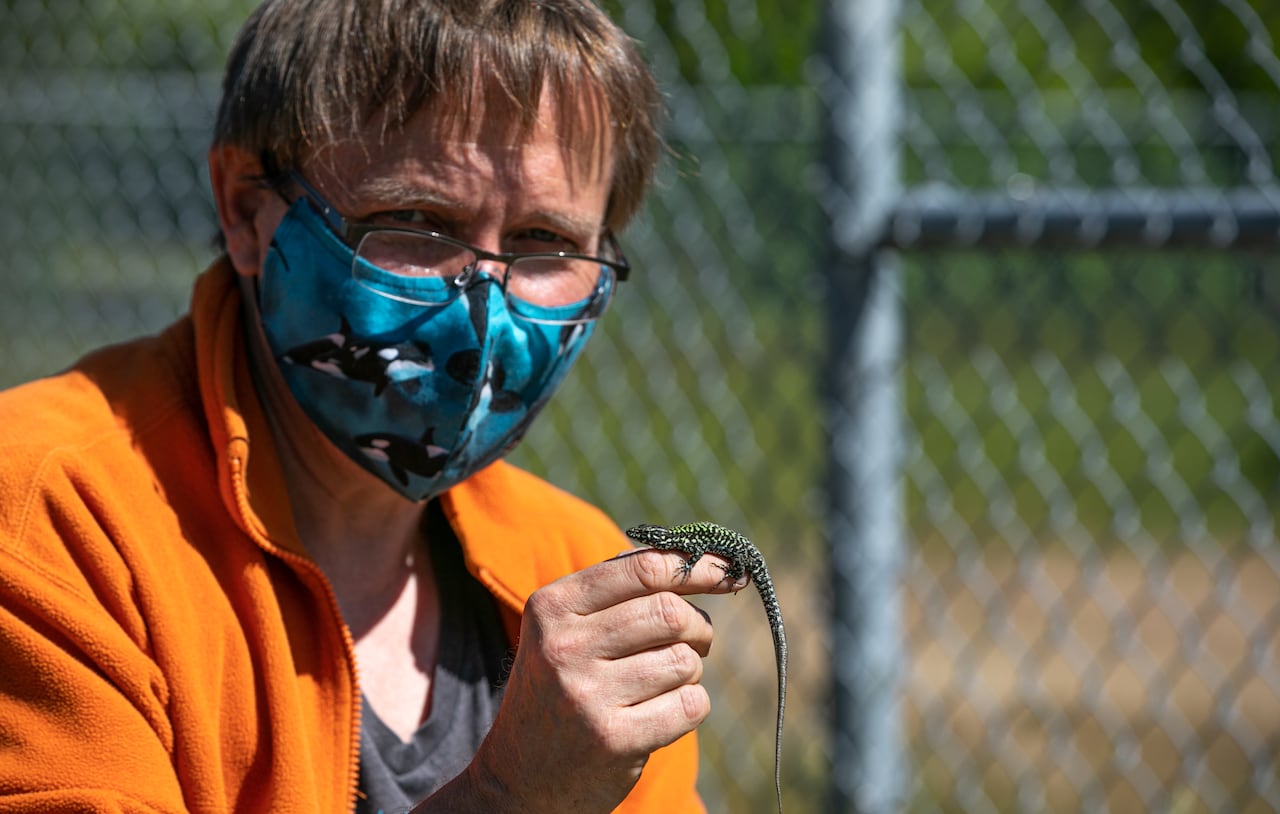
Gavin Hanke is shown holding a lizard on May 21, 2021. (Mike McArthur/CBC)
These lizards are omnivorous, consuming a variety of insects, spiders, and other invertebrates.
Their diet also includes slugs, ants, termites, earwigs, mason bees, honeybees, and bumblebees, along with fruits.
“If a ripe fig falls to the ground, they will eat that,” Hanke explained.
Stopping the spread
While the wall lizards have helped protect her strawberries this year, Menzies expressed concerns about their proliferation.
“I don’t wish to exterminate them. However, I also do not want them inside my house,” she stated.
“So far, I haven’t encountered one in my home, but the moment I do, my feelings about eliminating them may change,” she added.
Hanke suggested that the most effective method to deter the lizards is to maintain a “very uninteresting” garden.
“A plain, well-trimmed lawn is the kind of environment they prefer to avoid,” Hanke noted.
Wong mentioned that attempting to remove them from one’s yard could be futile if neighbors do not take similar actions, as lizards can simply re-enter from neighboring properties.
“It requires a collective initiative in the area,” Wong remarked.
Hanke stated that the reality is that it is too late to eradicate the lizards.
“If we were going to eliminate them, it should have been done around 1972 or 1973, because once they were beyond that initial release location, it became impossible,” he explained.
He pointed out that humans have significantly harmed our ecosystem, and ironically, these lizards thrive in man-made environments.
“It’s not surprising that, as an invasive species, they are able to occupy any available habitat, especially since we have disrupted the original habitats,” he stated.
“Thus, we are responsible, as well as accountable for introducing them here.”
Hanke advised against capturing the lizards and relocating them, as this could lead to their further spread southward.
“I believe it will only be a matter of years before they are seen in Washington state,” the curator warned.