
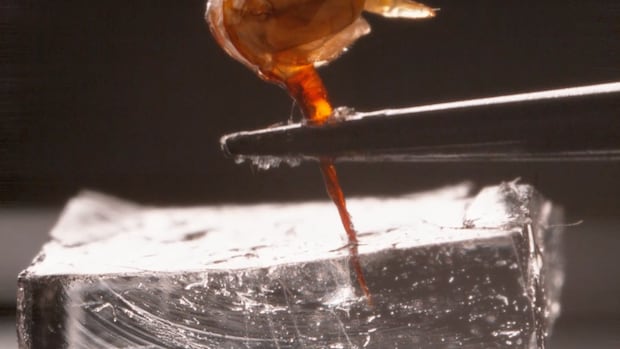

The stinger of the western honey bee (Apis mellifera) serves as a last resort weapon, intended to penetrate skin and inject venom, often leading to the demise of the worker bee itself.
Recent studies published in the Proceedings of the National Academy of Sciences are illuminating the effectiveness of this defensive mechanism.
“The ability to film them in action is a groundbreaking advancement made possible by modern camera technology,” stated Fiorella Ramirez Esquivel, the primary author and postdoctoral researcher at Macquarie University in Australia.

Researchers captured footage of how the western honey bee’s stinger penetrates a surface while simultaneously delivering venom.
Due to the rapid nature of bee stings, Ramirez Esquivel and her colleagues utilized high-speed cameras that can capture hundreds of frames in a second. The clarity of the venom sac and stinger, enhanced by strong lighting, allowed them to highlight the intricate structures within.
The experiments involved live honey bees, which had their stingers removed and were killed immediately afterward. Since the stinger remains functional for only about two minutes after detachment, Ramirez Esquivel explained that she had to act quickly.
“I take the stinger from the bee and then insert it into this artificial [skin substitute], and I have about four millimeters of space where precision is crucial,” she remarked to CBC News from Sydney.

At 100 frames per second, two distinct components can be observed in the chamber between the elongated needle and the large venom sac. These are valves that interact in a unique manner. (Ramirez Esquivel et al. 2026)
Double-piston mechanism
The findings reveal that two specialized valves perform dual functions: driving the barbed stinger deeper while simultaneously pumping venom from the sac into the target.
The research describes this as a “double piston mechanism,” though the system is far more intricate than a typical car engine, where a single piston moves up and down within a cylinder.
“Now, picture having two pistons that must move past each other as they operate,” Ramirez Esquivel explained, “and when they reverse direction, they need to collapse so that the fluid can flow around them.”
This intricate movement was replicated by the researchers using 3D printing, which helped them understand how the valves interact — allowing venom to flow continuously while also driving the stinger deeper.
Juliana Rangel, a professor of apiculture at Texas A&M University who did not participate in the study, found the videos captivating as they provide insights beyond the scanning electron microscope images and diagrams she is accustomed to.
“We have known about the stinger and its components for ages because we have been subjected to these stinging incidents for tens of thousands of years,” Rangel stated. “However, we previously didn’t understand how the venom continues to be dispensed for such an extended period after the stinger is released.”
According to the research, the stinger can twitch and move for as long as 15 minutes.
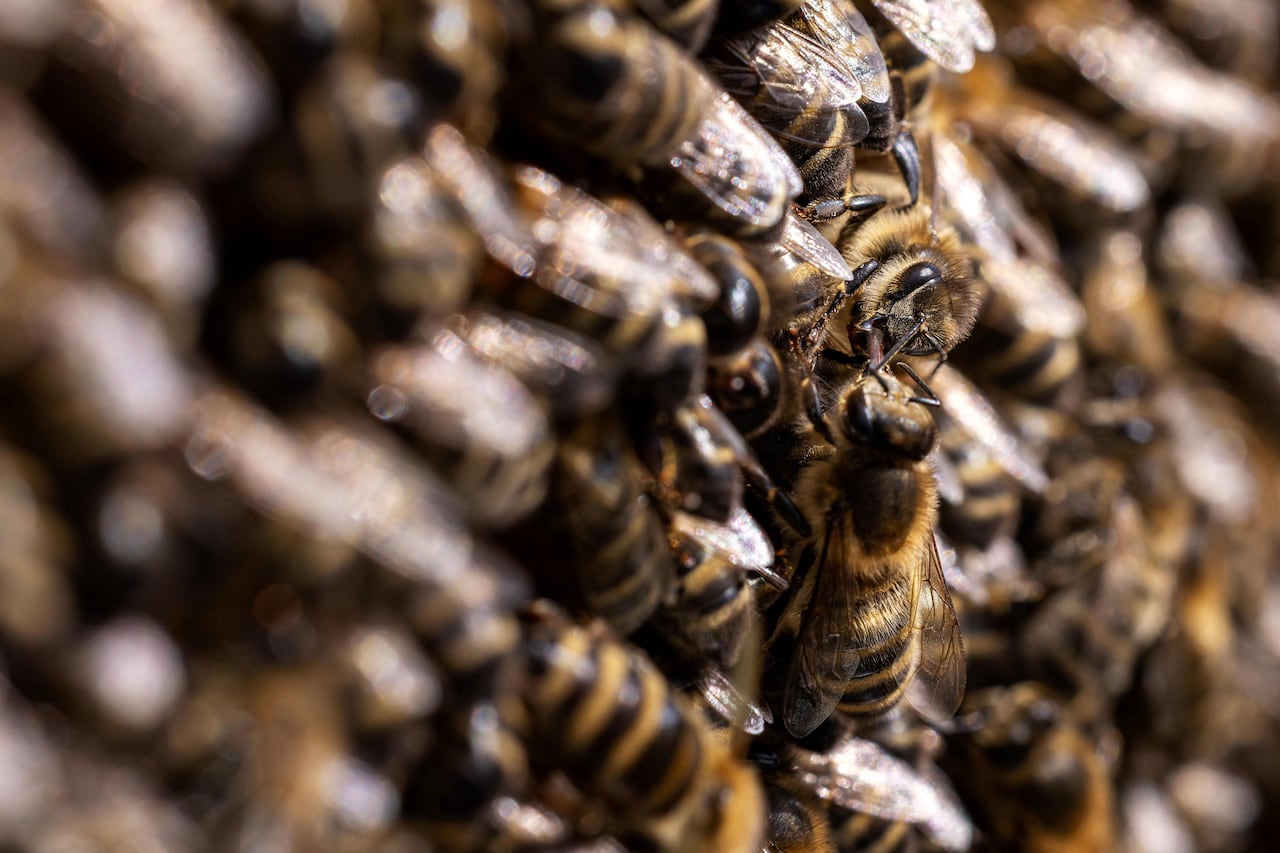
Honey bees are social insects, and experts assert that their stinging serves multiple purposes. (Joel Saget/AFP/Getty Images)
Kill and be killed
The process of shedding part of the body as a form of defense is known as autotomy, but not all bee species engage in this behavior. The western honey bee is a social insect, with its colony functioning as a “superorganism” that the workers defend. This extreme defensive strategy must provide more than what one small bee can achieve.
“The structure of this sting and the evolution of the stinging apparatus serves as an insurance policy,” Rangel shared with CBC News from College Station, Texas. “It signifies that the life lost was for a just cause: the protection of the larger colony.”
Rangel noted that nearly all other stinging bees lack barbs that help keep the stinger lodged in a victim because, unlike female worker honey bees, they need to survive for reproduction. Female worker honey bees are sterile and do not produce young.
Additionally, honey bee stingers release pheromones, chemical signals that summon other bees to assist in defending against threats.
Rangel mentions that while this defense mechanism may struggle against tougher skin or fur, the barbs and continued penetration likely enhance the likelihood of deterring an attacker.
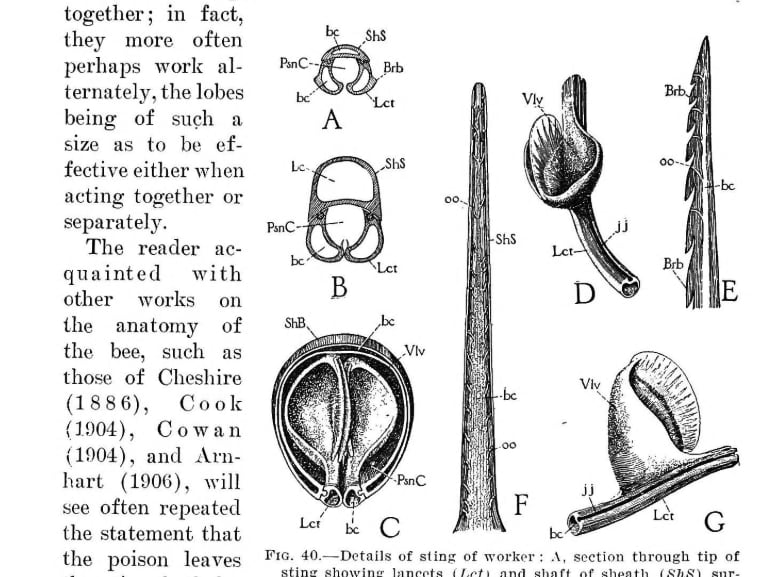
An illustration of the stinger from The Anatomy of the Honey Bee by Robert E. Snodgrass, published in 1910. (Cornell University Library/The Internet Archive)
Nature as a model
Although they are originally from Europe, western honey bees are now found globally and have been the subject of study for centuries.
“Our relationship with them dates back approximately 9,000 years,” noted Lauren Ponisio, an associate professor and ecologist at the University of Oregon. “There are cave paintings depicting people harvesting honey and wax from colonies. Active management only begins to appear with the Egyptians.”
Jump to 1758, when Swedish biologist Carl Linnaeus scientifically categorized the species. The study points out that their stingers were thoroughly documented in the early 1900s by American entomologist Robert E. Snodgrass.
However, through the use of high-speed videography, researchers are uncovering more about this intricate system — discoveries that may have potential medical implications.
“It doesn’t operate like a syringe that stops and starts. The plunger of a syringe moves down once and that’s all,” Ramirez Esquivel explained. “But with two effective plungers, continuous flow becomes possible.”
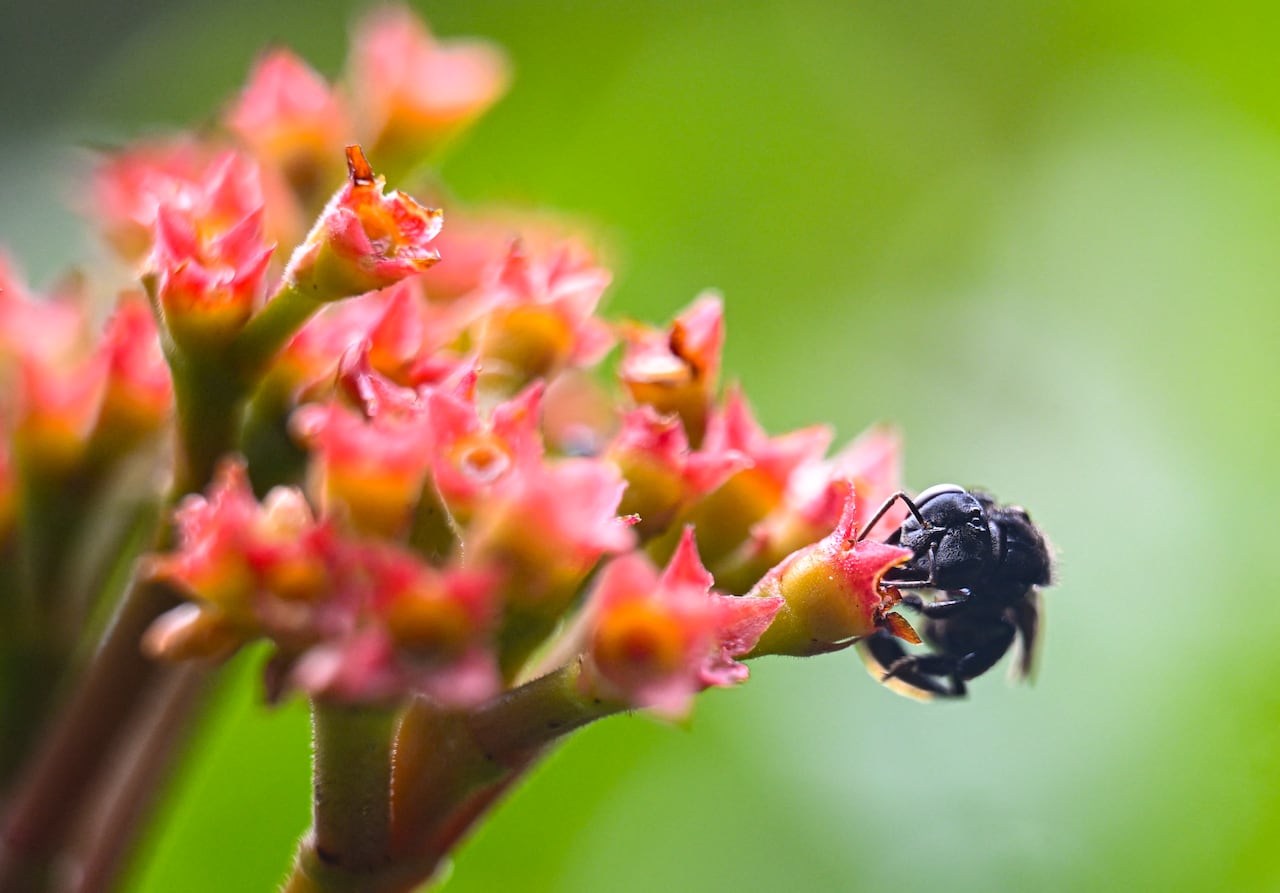
A black stingless bee (Trigona spinipes) is seen at the Metropolitan Natural Park, a protected area in Panama City on January 26, 2025. (Martin Bernetti/AFP/Getty)
Ponisio expressed that this research prompts curiosity about other honey-producing bee species that differ significantly from western honey bees, including those native to the Americas.
“It raises intriguing questions about other honey-producing bees that lack stingers, and how that has affected their survival,” Ponisio remarked.