
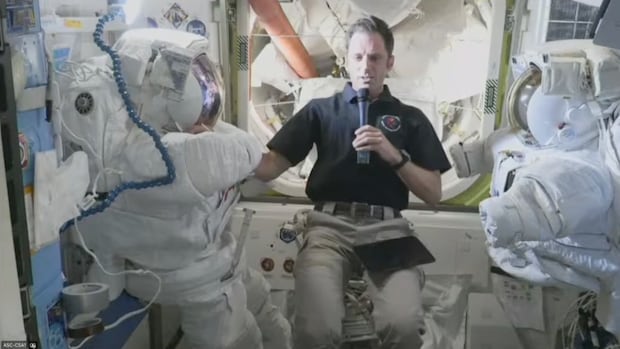

Astronaut Joshua Kutryk from the Canadian Space Agency arrived at the International Space Station (ISS) 11 days ago to embark on a six-month mission in orbit.
During his initial Q&A session with journalists while in space on Tuesday, he expressed that he is “having a blast” so far.
Kutryk mentioned that he is still adjusting to life in space, needing to relearn everyday tasks such as sleeping (“How do you position your neck when you sleep? What about your hands?”), eating, and handling tools.
“It’s like being two or three years old again, rediscovering the most basic aspects of life,” he remarked about the experience of living in microgravity. “It can be quite frustrating, but when you pause to look out the window and chuckle at your own struggles, it becomes very enjoyable, immensely gratifying, and makes you feel incredibly fortunate to be here on this mission.”
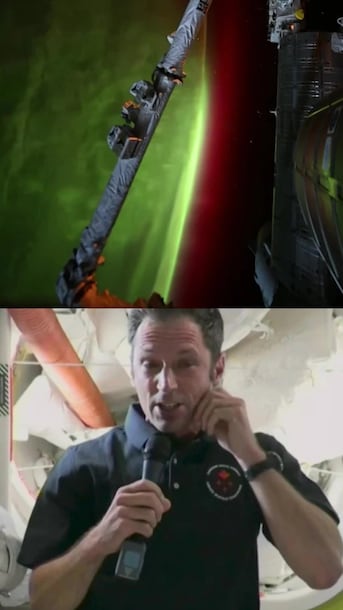
Answering questions from the ISS, Canadian astronaut Joshua Kutryk shared the ‘exhilarating’ moments of his launch into orbit and witnessing the northern lights from above. Kutryk is currently two weeks into a six-month mission as part of NASA’s SpaceX Crew-13, where he will engage in scientific experiments and essential maintenance tasks.
However, it’s not just about enjoyment; he has been working diligently.
Kutryk stated that he has already initiated scientific experiments, including one focused on mental health and another that tracks his vital signs.
‘Canada’s strong legacy in space’
This marks Kutryk’s inaugural journey into space. His mission follows only six months after fellow Canadian astronaut Jeremy Hansen orbited the moon during the Artemis II mission.
Kutryk expressed his hope that Canadians view this as a pathway to innovation and a “brighter future.”
-
This medical device heading to space with Joshua Kutryk is also helping people here on Earth
-
Joshua Kutryk’s launch to the ISS is another example of the important role Canada plays in space exploration
“I hope people recognize it as proof of what Canada is capable of,” he remarked. “It’s crucial because it showcases Canadian industry, academia, and commercial sectors at the forefront of spaceflight. This is how we innovate and advance new technologies.”
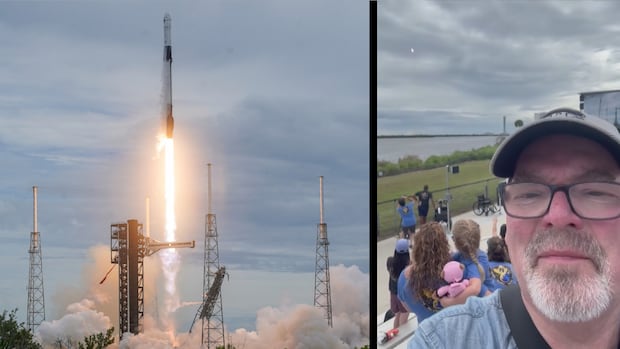
Ted Hupé reflects on the moment he witnessed his former Grade 6 student, Canadian astronaut Joshua Kutryk, launch into space on the Crew-13 mission to the International Space Station from Cocoa Beach, Florida.
Kutryk indicated that during the Q&A, he was flying over Vancouver and was about to pass over Quebec.
“I get to see a lot of the country from up here,” he shared.
He has also been treated to an astonishing view of the northern lights.
Additionally, he mentioned that he has lost five pounds since reaching the ISS, highlighting the significance of exercise and nutrition in a space environment.
Many of the experiments onboard focus on astronaut health.
One upcoming Canadian experiment, called T-Bone, employs 3D technology to examine changes in astronauts’ bone health. However, there are numerous other Canadian experiments underway.
Kutryk emphasized that Canada plays a vital role in space exploration.
“I wish for people to see the broader perspective. Canada’s presence here is essential,” he stated. “We gain numerous benefits from these missions, and we aspire to sustain Canada’s strong legacy in space as we move forward.”