
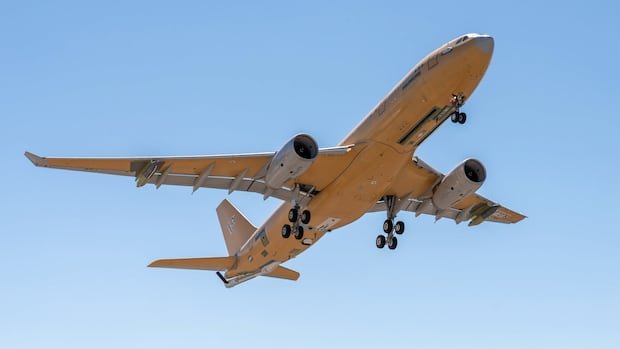

Canada’s air force is facing delays in receiving four new air tankers crucial for refueling fighter jets in the Arctic. The Royal Canadian Air Force (RCAF) provided an update on the CC-330 Husky fleet, which is set to replace the aging Airbus 310s. These wide-body jets serve as vital assets for the air force’s global operations, including transporting troops and the prime minister.
The first of the new aircraft is expected to be delivered to the RCAF by late 2027. In July 2023, Canada acquired nine Airbus A330s at a cost of approximately $3.6 billion, comprising five used jets with minimal service history from Kuwait Airways and four brand-new planes. The exact delivery schedule for the new aircraft had not been disclosed until now.
As of now, three of the used Airbus planes have been received, with one undergoing maintenance in Mirabel Airport, another being refitted in Switzerland, and the fifth in Spain for conversion into an air tanker. The first new-build tanker is undergoing testing in Spain, while the other three are being produced in Toulouse, France.
The RCAF’s fleet, including CF-18s and upcoming F-35s, relies on air tankers to support Arctic patrols. The new tankers will be equipped to refuel all NATO aircraft, unlike the previous models lacking essential refueling capabilities for certain aircraft types. Additionally, the new V-VIP Airbus being prepared for the prime minister will feature a “self-protection suite” to enhance defense against potential threats.
The air force anticipates achieving initial operational capability for the CC-330 Husky fleet by 2028-29, with full operational capability expected by 2032-33. Presently stationed in Ottawa, the jets will soon have new facilities in Trenton, Ont., and Edmonton. The existing fleet of Airbus A310s, known as the CC-150 Polaris, will remain in service until 2030, with one aircraft already retired and serving as a museum piece in Trenton.
A notable incident involving an A310 in Guam in 2023 highlighted safety concerns, leading to the retirement of one aircraft. The investigation identified lapses in safety procedures and maintenance practices, prompting the air force to prioritize the transition to the new tanker fleet for enhanced operational efficiency.