
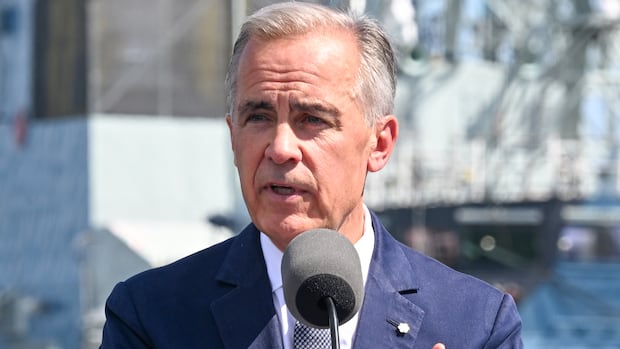

Prime Minister Mark Carney has expressed his willingness to return to negotiations with the Trump administration, contingent upon the U.S. demonstrating a genuine interest in fostering an economic partnership rather than viewing Canada as a “subsidiary.”
“If the Americans approach the negotiating table with the right mindset towards our industries and in a genuine partnership, we will certainly engage,” Carney stated in Lévis, Quebec, on Monday.
He pointed out that a trade agreement already exists between Canada and the U.S. (CUSMA). While Carney acknowledged its benefits, he also suggested that it could be enhanced for the advantage of all involved. However, he emphasized that the U.S. must refrain from threatening the economic stability of Canadian businesses and citizens.
“A negotiating stance that treats Canada as a subsidiary of the United States, which disadvantages Canadian industry compared to American counterparts, and establishes terms that lead to ongoing challenges for Canadian industry—this is unacceptable,” Carney remarked.
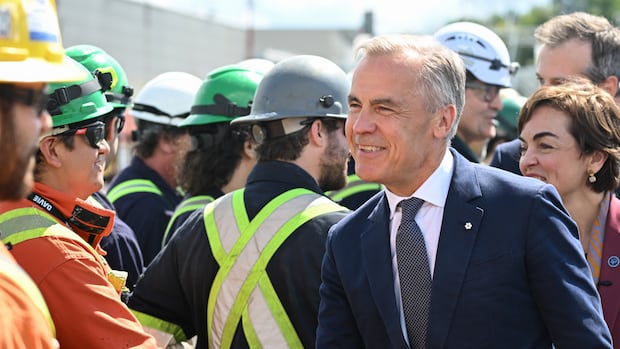
Prime Minister Mark Carney noted on Monday that U.S. President Donald Trump is following a course of action that the government anticipated by focusing on the automotive sector. ‘What message does that send to workers in Michigan, Ohio, Kentucky, and Alabama who rely on Canadian demand?’ Carney queried.
On Friday evening, Carney declared that Canada was withdrawing from negotiations after the U.S. introduced “last-minute changes” deemed “unfair” and “not economically sound” by the Canadian government.
These demands, Carney explained on Saturday, would have limited Canada’s capability to enter into trade agreements with other nations and jeopardized the French language by reducing support for French-language media and the requirement for bilingual product labeling.
Approximately $28 billion worth of Canadian exports to the U.S. faced 50 percent tariffs over the weekend.
Unveiling Trump’s objectives
The prime minister further stated that the auto deal sought by the U.S. would have gradually undermined the industry, which he could not accept.
On Monday, U.S. President Donald Trump announced via social media that tariffs on Canadian automobiles, car parts, and steel will rise to 50 percent starting January 1.
“Canada will no longer be treated like a state!” he tweeted.
-
Ottawa’s counter-tariffs find broad support in Canada as businesses brace for trade war impact
-
Carney states trade deal became untenable when U.S. ‘asked too much and offered too little’
-
Analysis
Mark Carney does not prevent the U.S. from driving negotiations to a stalemate
In response to Trump’s latest threats, Carney remarked that not only was the U.S. counteraction expected, but it also provided further insight into the administration’s ultimate goals.
“Throughout these discussions, it has become evident that the Americans aim to dismantle our major industries, including those in the automobile and aluminum sectors, through unfair negotiation tactics,” Carney stated in French.
“This was one of the primary reasons we chose to walk away. It was an unfavorable agreement.”
During several media interviews on Monday, Ontario Premier Doug Ford proposed that Canada should consider imposing a surcharge on electricity in reaction to Trump’s latest tariffs.
“We aren’t the only province that supplies electricity to the U.S. New Brunswick, Quebec, British Columbia, and Manitoba do as well,” Ford mentioned in Hamilton.
“We need to unite, collectively decide if we are going to impose surcharges on electricity.”
The premier rationalized such a strategy by stating it increasingly makes little sense to export energy to the U.S. only for it to be used in manufacturing products that compete with Canadian goods.
Utilizing electricity as leverage
When asked about his support for this approach, Carney noted that the U.S. relies on Canada for energy, essential minerals, crucial auto components, and other industrial products, despite Trump’s assertions to the contrary.
“However, we will remain composed and optimistic … and yes, if other actions become necessary, we will consider them. But we are beginning with positive initiatives such as this one today,” Carney remarked.
The prime minister was in Lévis to unveil $11.3 billion in funding for Quebec’s shipbuilding sector to construct six new icebreakers for the Canadian Coast Guard utilizing Canadian steel.
Quebec Premier Christine Fréchette, present at the event, stated that her province will currently focus on strengthening the economy and has not yet contemplated imposing surcharges on energy directed towards the U.S.
“Nothing is off the table. We are entering a new phase,” Fréchette commented.
While Carney indicated that his team would only return to the negotiation table under specific conditions, U.S. Vice-President JD Vance attended a rally in Brewer, Maine, on Monday where he suggested that discussions “were still ongoing and I want to be respectful to the process.”
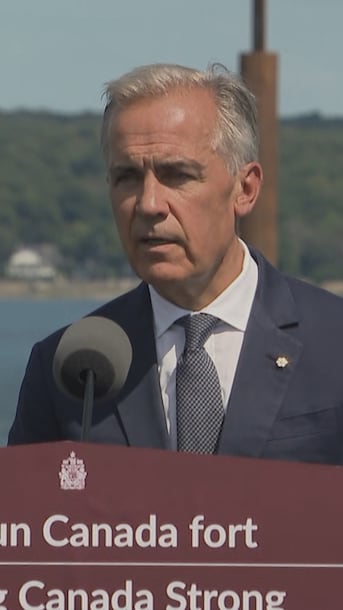
When asked by the Globe and Mail about when Canada would return to the negotiation table to discuss a trade agreement with Washington, Prime Minister Mark Carney stated that his delegation would not accept perspectives that regard Canada as a ‘subsidiary’ of the U.S. Carney’s remarks followed U.S. Transportation Secretary Sean Duffy’s comment that Canada would be back at the table due to its reliance on the U.S. for security.
Vance echoed sentiments expressed by President Trump, labeling Canada and China as the two “worst countries in terms of trade policy in the world.”
Initially referring to Canada as a “state,” the vice-president appeared to correct himself by calling it a “country” before describing it as ungrateful.
“Canada is a nation that has underinvested in its military and would practically be invaded by a foreign power without the protective umbrella of the United States,” he remarked.
“How does Canada respond to such support? By treating the people of Maine fairly? No. They impose absurd tariffs and other non-tariff barriers on Maine products entering Canada and expect no pushback from Maine or anyone else? We are tired of it,” he stated.