
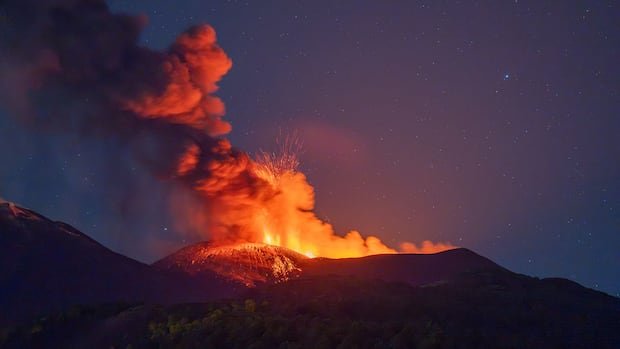

Flights at Catania airport in Sicily faced a halt once again on Wednesday due to fresh ash emissions from Mount Etna, Europe’s tallest and most active volcano. This led authorities to extend airspace restrictions, causing disruptions during the peak summer holiday season. The impact of the recent eruption extended to neighboring Malta, resulting in flight cancellations and significant delays as volcanic ash drifted south across the Mediterranean.
Mount Etna frequently disrupts operations at Catania airport, which serves as Sicily’s primary gateway and is the fifth busiest airport in Italy in terms of passenger traffic. Recent volcanic activities have significantly affected travelers in the region.
Images captured lava flow and smoke rising from the volcano’s crater during the eruption on July 5 and 6. Satellite imagery displayed the smoke spreading from Mount Etna, while a drone view showcased lava flowing down a slope during the eruption.
Travel disruptions have plagued eastern Sicily since last week, triggered by renewed volcanic activity and changing winds carrying ash across the area. Stranded passengers were seen waiting at the terminal following the closure of Catania airport due to the ash cloud from Mount Etna on Monday.
Although conditions seemed to be improving on Wednesday, Malta International Airport continued to caution passengers about potential disruptions. The prolonged restrictions at Catania have increased the burden on other airports in Sicily. Palermo Mayor Roberto Lagalla mentioned that the city’s airport had managed 190 flights that were initially supposed to operate through Catania in recent days. Furthermore, Comiso airport, a smaller facility south of Catania, has resumed full operations after suspending flights on Tuesday evening due to ash from Mount Etna.