
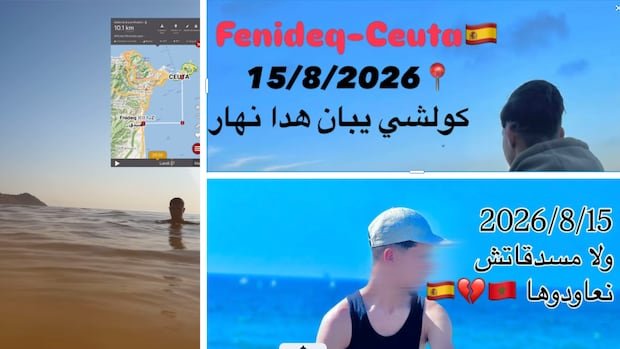

In the lead-up to the recent surge of migrants arriving in Europe, a brief Instagram video went viral with 1.4 million views. The video depicted a young man partially submerged in water, followed by a view of land in the distance, with a map illustrating a sea route from Fnideq, Morocco, to Ceuta, a Spanish enclave in Africa. The account owner indicated in comments that they had successfully reached their destination.
Numerous posts on Instagram, TikTok, and other platforms played a role in mobilizing two waves of irregular migration from Morocco to Ceuta. These accounts are part of a larger online community focusing on migration-related content like music, memes, and imagery. Some of these platforms seem to exploit the aspirations of mostly African and Middle Eastern youth seeking better opportunities abroad.
There is a debate among governments and organizations regarding whether a single entity orchestrated the events in Ceuta or if migration was strategically used for geopolitical purposes. However, it is evident that misinformation propagated by various online communities fueled the influx of migrants to Ceuta this summer.
A visual investigations team at CBC, in collaboration with Sebastian Vandermeersch from Bellingcat, identified multiple social media accounts, particularly on Instagram, that were active prior to the initial wave on July 30. The dissemination of misinformation, suggesting that a Spanish court ruling would allow migrants to enter without opposition, led to a surge of posts promoting the idea of a possible crossing. This resulted in over 72,000 people entering Ceuta on July 30, creating chaos and sparking a political crisis.
While most individuals who crossed in July have returned to Morocco, approximately 5,000 remain in Ceuta, with some residing on a beach with assistance from charities. Tragically, nearly 100 people lost their lives attempting the journey.
The online surge was fueled by the fact that migrants had been successfully reaching Ceuta even before the court ruling. The Mixed Migration Centre noted that Ceuta had become a popular entry point into Spain, possibly due to increased patrols on other migration routes.
Although social media played a role in shaping the misinformation, it did not create the desire to migrate. Many accounts reflected the desperation and disillusionment of young people in North Africa and beyond, using aspirational content to promote migration as a solution to their challenges.
As Moroccan and Spanish authorities prepared for another wave on August 15, thousands of police were deployed on both sides of the border, resulting in the arrest of nearly 300 migrants. The government monitored social media messages encouraging the crossing and took action against those responsible.
Accounts promoting migration-related messages are primarily based in North African countries, including Morocco and Algeria, with some originating in Italy and Turkey. These accounts use aspirational language and images to attract followers, often hinting at European destinations without explicitly stating how to reach them.
In conclusion, the influence of social media in shaping migration narratives underscores the deep-rooted desperation and lack of opportunities faced by many young individuals, driving them to seek a better life through irregular means.