
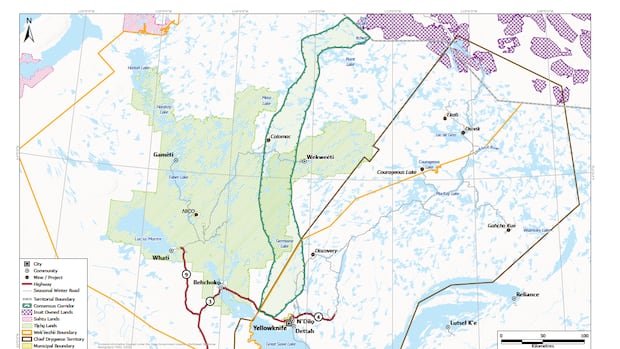

The Yellowknives Dene First Nation and the Tłı̨chǫ government have recently agreed on the designated location for the Arctic Economic and Security Corridor. This corridor is set to be a 400-kilometre all-season road linking the Grays Bay Road and Port in Nunavut to the N.W.T. highway system. It is part of the nation-building projects aimed at enhancing military presence and mineral exploration in Northern Canada, with potential spur roads connecting Wekweètì and Gamètì to the main route.
Taking the lead on this initiative are the Yellowknives Dene First Nation and the Tłı̨chǫ government, collaborating with both territorial and federal authorities. Tłı̨chǫ Grand Chief Jackson Lafferty expressed enthusiasm, stating, “It is exciting to show Canada how we can lead and design major projects as Indigenous nations.”
The proposed corridor spans approximately 30 kilometers wide, traversing the Slave Geological Province. Leaders stress that this corridor is a preliminary step and not the final road. Yellowknives Dene First Nation Chief Ernest Betsina and Chief Fred Sangris clarified, “This is a proposed corridor, not a final road, and that matters.”
Apart from its potential for mineral exploration, the corridor intersects caribou habitat and migration paths. Emphasizing their commitment to environmental preservation, both nations highlighted that the corridor’s route was meticulously chosen to minimize impacts on the caribou population.
The consensus on the corridor’s location followed over a year of collaboration and research, incorporating community-led studies, traditional knowledge, and Western science. While acknowledging their differences, both nations recognized the importance of working together to achieve common goals.
Premier R.J. Simpson affirmed the government of the Northwest Territories’ support for the consensus reached by the two nations, emphasizing the significance of Indigenous-led development and governmental partnerships. Once finished, the corridor will serve as Canada’s primary land-based connection to Nunavut’s Arctic coast.
Future steps involve gathering feedback from members of the Tłı̨chǫ government, Yellowknives Dene First Nation, neighboring Indigenous groups, and local communities to shape the project’s direction. Sangris and Betsina stated, “What people tell us in the weeks and months ahead will help shape the path forward.”