
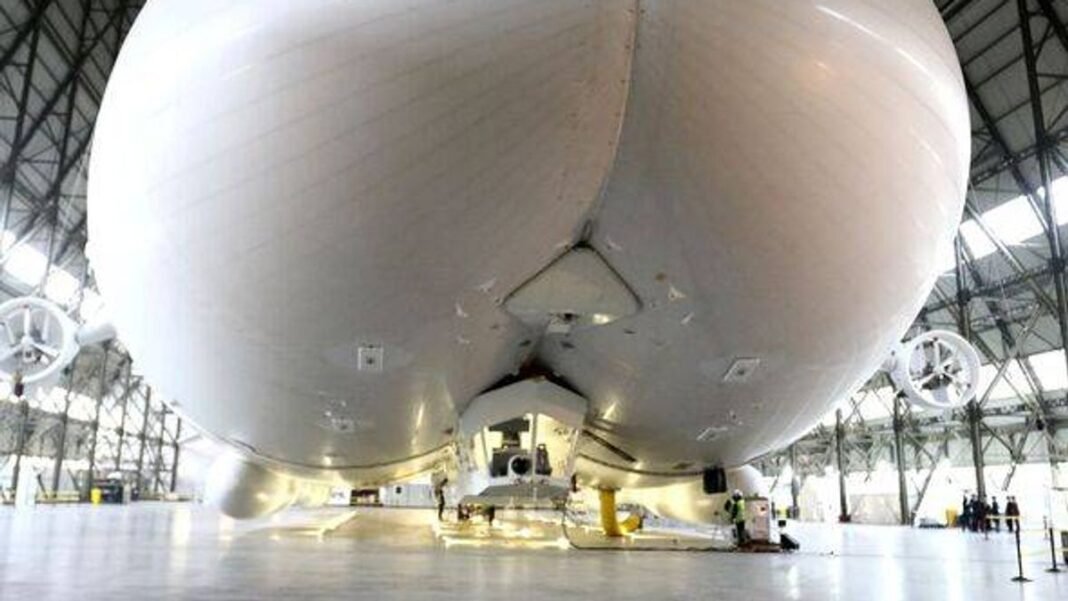

The world’s largest aircraft, humorously known as the “flying bum” due to its unique design, can land without needing a traditional runway. The £60 million “mega airship” boasts amenities like double bedrooms and an onboard bar, aiming to revolutionize air travel.
Manufactured by Hybrid Air Vehicles, the Airlander 10 is envisioned to operate commercially by 2029, standing at an impressive 92 meters in length as the largest aircraft globally, promising to transform the travel industry.
The company anticipates that the Airlander 10 will reach remote locations inaccessible to most aircraft, thanks to its ability to take off and land on various surfaces such as grass, gravel, sand, marsh, or even water, requiring minimal distance for takeoff and landing.
The aircraft’s unique feature of not requiring a paved runway opens up opportunities for flexible use and exploration. With a capacity of up to 100 passengers, it could facilitate trips to otherwise hard-to-reach places, offering a versatile and efficient mode of transportation.
Although the “flying bum” moniker is embraced by the company, plans for a more refined commercial version are underway, emphasizing comfort and functionality. The Airlander 10, equipped with a helium-filled flotation system, aims to provide a spacious and peaceful flying experience, departing from the noisy and cramped cabins of traditional airplanes.
With plans to construct an enhanced Airlander 10 in Doncaster within the next 12 to 18 months, Hybrid Air Vehicles eyes a future where the aircraft gains approval for mass production, potentially yielding up to 24 units per year from 2030, pending Civil Aviation Authority clearance.
Offering a quieter and more comfortable flying experience, the Airlander 10 cruises at 3,000 meters without the need for air pressurization, promising a serene journey for passengers. While its speed is slower than conventional jets, it boasts impressive endurance, capable of covering 4,000 miles in a single trip.
In a bid for sustainability, Hybrid Air Vehicles collaborates with ZeroAvia to power the Airlander 10 with hydrogen-electric engines, aiming to significantly reduce emissions compared to traditional kerosene-powered aircraft, aligning with eco-friendly aviation trends.
ZeroAvia’s Val Miftakhov highlights the Airlander’s potential to revolutionize air travel with its efficiency and range, opening new market opportunities. The partnership between the two companies not only aims for environmental benefits but also envisions creating job opportunities and growth in the UK aerospace sector.