
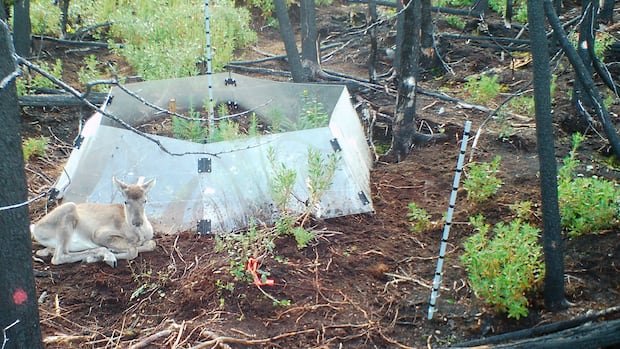

Wildlife in Newfoundland’s forests has been wreaking havoc on the research equipment of Lucas Brehaut, a wildfire researcher with the Canadian Forest Service. Brehaut’s study focuses on how forests in Atlantic Canada regenerate after wildfires, an increasingly common occurrence despite the region’s cooler and wetter climate. Following a forest fire in 2022, Brehaut embarked on a project to observe forest regrowth under the influence of climate change-induced temperature rises. To simulate warming effects, his team deployed 19 open-top chambers (OTCs) resembling mini greenhouses around planted seedlings. These OTCs can elevate temperatures by one to three degrees, mimicking a warmer environment. The study is currently in its third year out of a five-year duration.
During routine checks in September 2023, Brehaut encountered unexpected challenges. Various wildlife species, including caribou, moose, black bears, rabbits, coyotes, and owls, had tampered with the research equipment. Cameras initially intended for monitoring snow depth captured the animals interfering with the OTCs. Approximately 11 out of 19 sites suffered damage, with some animals even absconding with temperature sensors.
Despite facing setbacks, Brehaut remains understanding, acknowledging the animals’ natural curiosity and behaviors in their habitat. Kaitlyn Gaynor, an assistant professor at the University of British Columbia, explained that animals are naturally drawn to novel objects in their environment, driven by curiosity or the potential for food resources. She highlighted the importance of minimizing human scent on equipment and swiftly conducting fieldwork to reduce animal interference.
Animal disruptions in research are not exclusive to Newfoundland, as Gaynor shared her experiences in Mozambique, where baboons, hyenas, and elephants frequently interacted with research equipment. She emphasized that animal interference poses a significant challenge in field research, often causing equipment damage. Brehaut also mentioned human-related incidents, such as snowmobiles inadvertently damaging his research sites during snowy winters in Newfoundland.