
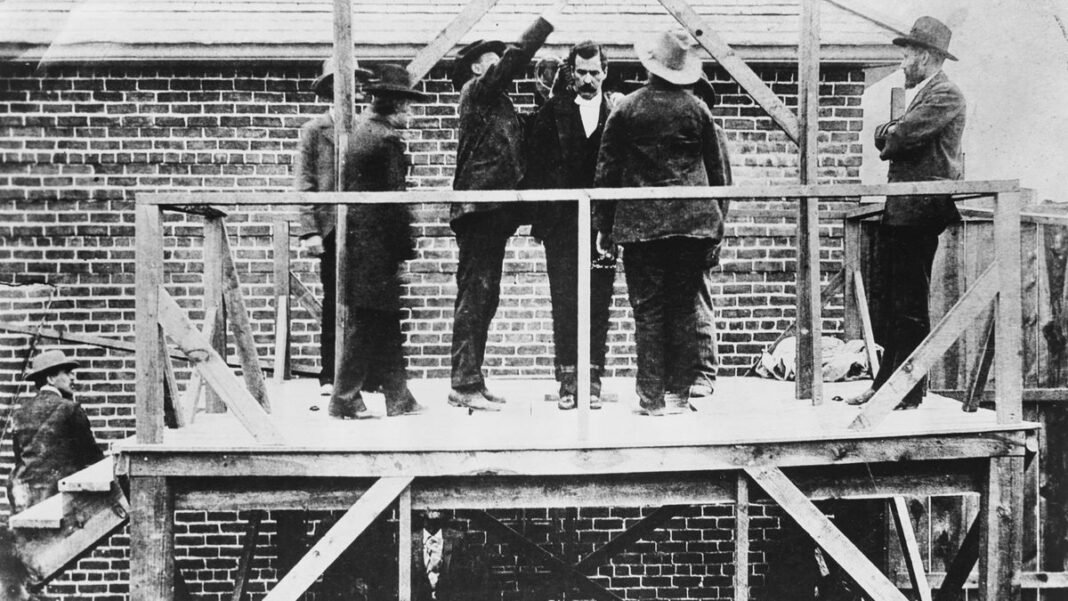

A train robber met a gruesome fate when a botched hanging resulted in his decapitation and blood spurting from his neck.
Thomas Edward Ketchum, hailing from Texas, became infamous as a member of the notorious ‘Hole-in-the-Wall’ gang in the late 19th Century in the United States. His criminal activities drew the attention of law enforcement across several states, ultimately leading to his capture following a failed train heist in 1899 near Folsom, New Mexico.
Ketchum sustained severe injuries during the robbery, getting shot in the arm by the train conductor, which resulted in the amputation of his right arm. Subsequently, he faced trial in Clayton, where he was found guilty of attempted train robbery and sentenced to death by hanging.
On the morning of April 26, 1901, a significant crowd assembled in Clayton for what was promoted as a major public spectacle. Businesses shut down, bars opened early, and vendors sold souvenir dolls of Ketchum mounted on a hanging stick.
However, behind the scenes, inexperienced executioners made a crucial error. They had tested the rope with a 200-pound sandbag the night before and failed to remove it, causing the rope to behave like a rigid wire when the trapdoor opened.
The combination of an excessively long rope, Ketchum’s weight gain while in custody, and the imbalance from his amputated arm led to a grotesque and tragic execution.
That afternoon, Ketchum was released through the trapdoor, resulting in his head being completely detached from his body. Only the black hood prevented it from rolling away, necessitating the executioners to reattach it for his public burial.
Sheriff Salome Garcia vividly described the shocking scene, stating, “Everyone present held their breath as his head was seen severed from his body upon the fall. His body landed on its feet momentarily, then swayed and collapsed, with streams of blood gushing from his neck in a confronting sight.”
Ketchum’s final words were reportedly, “Dig my grave deep, boys. Let her go, boys.”
The aftermath of the disastrous hanging became notorious, with photographs and postcards distributed depicting the decapitated body labeled as “Body of Black Jack after the hanging showing head snapped off.” Ketchum’s case remains one of the most extreme instances of a failed execution in the history of the United States.
Although infamous, in the 1930s, Ketchum’s body was relocated from the original Boothill site to the current Clayton Cemetery, where his grave continues to attract curious visitors intrigued by the grim tale.
At Reach and across our entities we and our partners use information collected through cookies and other identifiers from your device to improve experience on our site, analyse how it is used